34 points surprisetalk 1 day ago 5 comments
peri-cl 2 hours ago | parent
Dipoles, like magnetic fields and planetary tidal forces, decay as an inverse R^3. That's less intuitive.
srean 2 hours ago | parent
Things get interesting in 2d flatland.
There the field or force has to decay as 1/r because the circumference of the boundary scales as O(r). But that's the field, to get to the potential you need to integrate and then you get a function that is logarithmic with distance.
A consequence of that is the potential does not drop to zero as you go further away. Unlike what is the case for the 3d case.
If you have heard that about a random-walking bird that returns infinitely often but a random-flying bird one that doesn't, that's sorta related.
Totally unrelated, was quite thrilled to see this map of the sphere
https://substackcdn.com/image/fetch/$s_!8JEP!,f_auto,q_auto:...
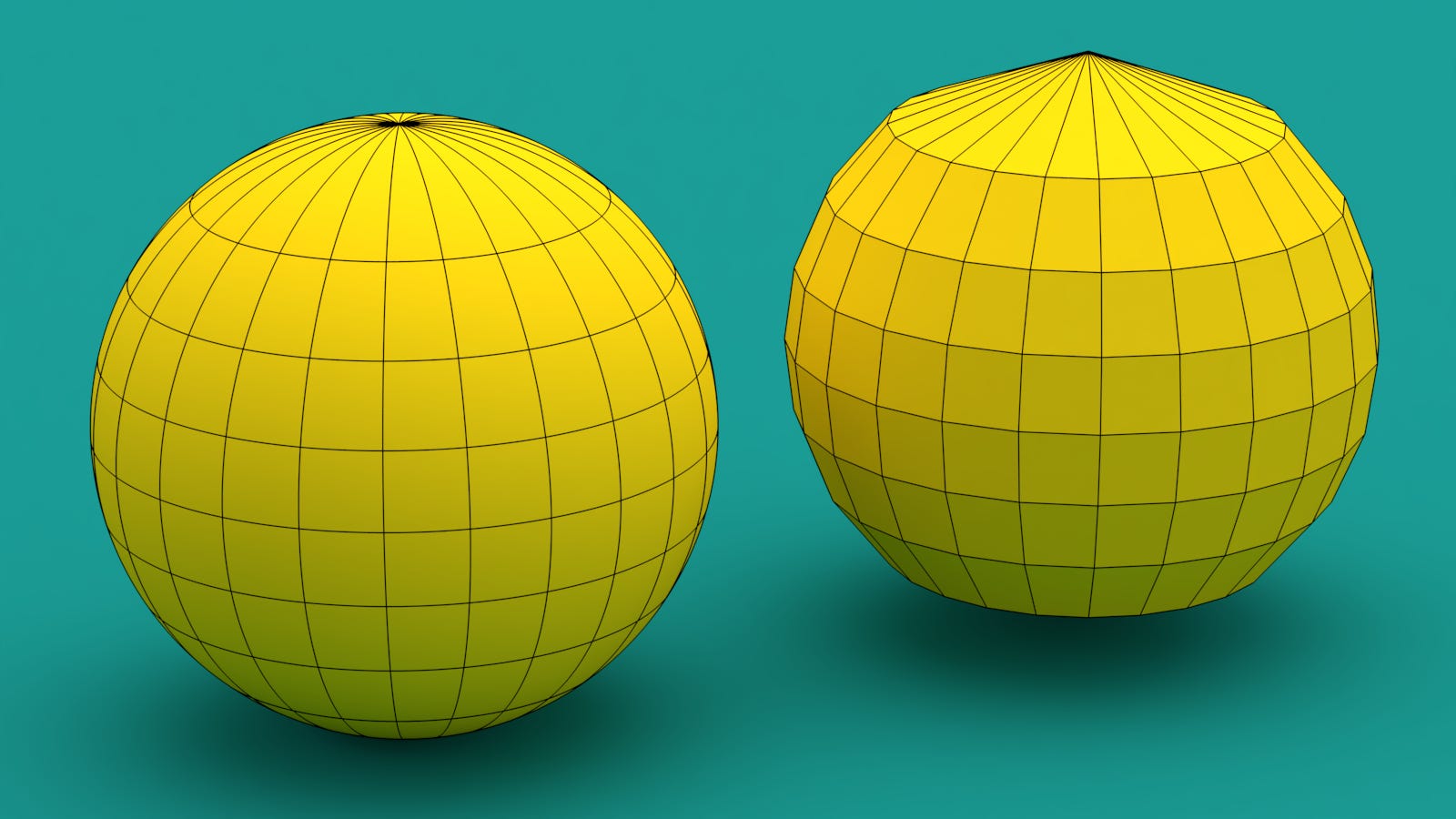
because I had been entertaining myself by making toy globes out of paper and it seems this polyconic map was the one I had used (an interrupted version of this).
The more conventional way is to use gores using interrupted sinusoidal that look like a string of lobes connected at their common equatorial hip.
https://www.wolframcloud.com/obj/resourcesystem/published/De...
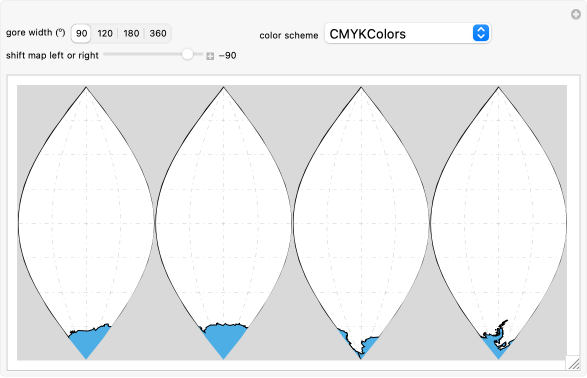
What I was working with were more like flowers, one for each hemisphere, with the pole at the center.
feoren 33 minutes ago | parent
The integral of const/r^2 doesn't drop to zero as r gets larger, but approaches some constant. Unlike const/r, which is unbounded as r gets larger. So potential is bounded in R3, but not in R2.
redwood 2 hours ago | parent