58 points zdw 23 hours ago 30 comments

gus_massa 2 hours ago | parent

> You turned it sideways. Using a colon, a dash, and a parenthesis character in series, you could make a sideways smile or frown. It looked like this: [happy-face] or [sad-face]

Did the editor repace :) with [happy-face]?

Cockbrand 1 hour ago | parent

Maybe the author uses a CMS that's supposed to replace tags like [happy-face] with an emoji, but something broke?

fasola 1 hour ago | parent

??? This isn’t on the linked page.

DroneBetter 2 hours ago | parent

> There was also the Japanese JIS standard keyboard

is a particularly humorous instance of https://en.wikipedia.org/wiki/RAS_syndrome

applfanboysbgon 1 hour ago | parent

I don't think I've ever seen someone do this from both sides of the same abbreviation (eg. Automated ATM Machine) before now, that's quite amusing.

amelius 1 hour ago | parent

No amount of drooling over Apple keyboards will make me forget that Apple's designers didn't add keys for basic functions such as Copy and Paste, Undo and Redo.

Cockbrand 1 hour ago | parent

The Extended Keyboard II came with a plastic overlay for the function keys. It showed Cut/Copy/Paste for F2/F3/F4 respectively. See https://chrispeak.com/2022/04/08/apple-extended-ii for a photo.

Not sure if this was ever supported system-wide in any way, though.

kps 9 minutes ago | parent

The Extended Keyboard not-II had the words printed below they keys. https://deskthority.net/wiki/File:Apple_M0115_top.jpg

spijdar 1 hour ago | parent

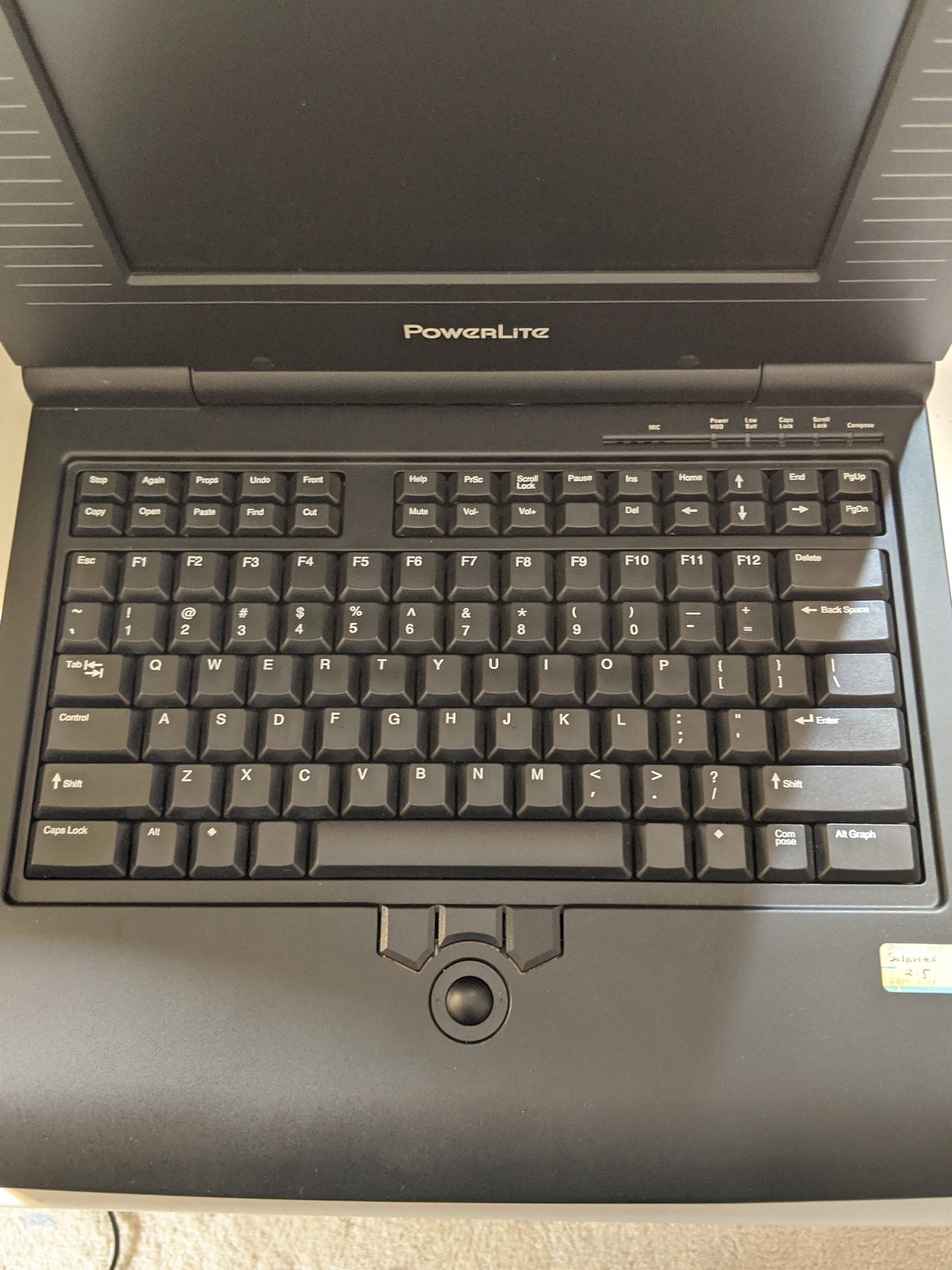
Having seen laptops with dedicated copy/paste/undo/redo keys, I think Apple can be forgiven for not going down the function key rabbit hole: https://pomelo.shockfox.net/pub/img/powerlite.jpg

(Yes, they could have just replaced the "regular" function keys with copy/paste keys, but I feel like that would have gone over about as well as the various times they've, uh, tried to replace the function keys)

amelius 1 hour ago | parent

The least they could have done was print "Copy", "Paste", etc. on the keys that we now use for those tasks.

roldie 1 hour ago | parent

The lack of delete has always annoyed me (and still does). I hate that I have to press fn backspace, or cursor to the end of the word.

leoc 24 minutes ago | parent

I don't see a clear advantage over the the ZXCV shortcut placement which the Macintosh team chose. (The original Finder had no specific Redo shortcut because it was single-undo and ⌘-Z performed both undo and redo.) Even well-placed dedicated keys on a Xerox-style (or later Sun-style) "fun cluster" https://www.youtube.com/watch?v=pBiWtJJN5zk to the left of the alphabetic cluster would have forced the hand to move further away from the home row. Of course ZXCV is much less well-adapted to the left-handed, but that would probably be true of any dedicated keys as well, unless they were mirrored on both sides of the keyboard.

Cockbrand 1 hour ago | parent

The weird Canadian helm icon on the Control key caught my eye in particular.

Findecanor 1 hour ago | parent

The symbols are from a weird ISO/IEC standard (9995-7 ?) that never really caught on except in a few places. I have seen the lock-key symbols more often on lock light panels than on keycaps.

bawolff 53 minutes ago | parent

I recall seeing that on typewriters when i was a kid (in the 90s). I dont know if i ever saw it on a computer keyboard.

behnamoh 1 hour ago | parent

I wonder why people stopped adding symbols to ASCII. The number row on Macs is just these characters:

    ~!@#$%^&*()_+
And every programming language uses a subset of these. But why these symbols? Why didn't people add more symbols to the keyboard?

kevin_thibedeau 1 hour ago | parent

ASCII is 7-bit and fully filled out. Every other extended character system prior to Unicode was sporadically supported. C has digraphs and trigraphs because even the ASCII punctuation wasn't guaranteed to be available on all keyboards. IBM, notably had an APL typeball for their Selectric derived terminals but that was equivalent to switching character sets and not something that could be considered universal prior to Unicode.

II2II 1 hour ago | parent

ASCII is a 7-bit code, so there are only so many symbols one can add. Prior to ASCII, you had codes that used as few as 5 bits. Early C had the option to use digraphs to represent various forms of parenthesis, simply because symbols like {} and [] were not universal.

(Strictly speaking, people did continue adding symbols. We used to talk about code pages: when the MSB was 0, the other 7 bits were ASCII. When the MSB was 1, the other 7 bits were a user selected code pade.)

Findecanor 54 minutes ago | parent

Many European layouts do have more symbols outside ASCII. For example German has ° (degree) and ß (ess-tset) and § (paragraph). German PC keyboards also tend to have µ on the M key, but it is available with the right Alt key.

Macintosh keyboard layouts tend to have many symbols on Option-combinations but they are not always printed.

kps 2 minutes ago | parent

>And every programming language uses a subset of these.

You might like https://juliamono.netlify.app/#fnref:zscode

Sardtok 1 hour ago | parent

Aaaah, he's got carriage return and enter mixed up. The whole reason for the symbol being an arrow returning to the beginning of the line, is because it's the return key. I love the Canadian enter symbol, an arrow pointing into a box.

fasola 1 hour ago | parent

Enter appropriated the same “arrow returning” symbol long ago, and the key is colloquially known more often as Enter these days.

xnx 1 hour ago | parent

2008 song about the Apple key by Hot Lava: https://www.youtube.com/watch?v=ts3tLs6xB1U

II2II 1 hour ago | parent

I'm wondering where those Canadian keyboards are used. I live in Canada, have seen plenty of multilingual keyboards, and have seen those symbols perhaps once. Even so I can't be sure it was on a keyboard. I just recognized one of the symbols.

bawolff 55 minutes ago | parent

I suspect its Quebec only

kps 8 minutes ago | parent

Québec and federal governments.

stuart78 59 minutes ago | parent

From a visual perspective I miss some of those more esoteric symbols, but the current Apple (US) keyboard gets it right. Symbols with text labels for modifiers and clear pictographs for the function keys (though the F3/Mission Control icon is a bit unclear until you click i and the behavior of F5/mic seems unhelpful). I just remember a few too many family tech support issues trying to help a struggling relative understand that command and 'open apple' are the same thing.

bhouston 12 minutes ago | parent

I think the increased use of symbols was because both Europe and Canada are multilingual m, right?

cosmic_cheese 10 minutes ago | parent

On the JIS 2003 model, the more traditional Control position is great (it’s how I map my boards) but the Caps Lock positioning is really good too and makes so much sense with how infrequently it’s used. Very little risk of accidentally hitting it. I wonder why more boards haven’t adopted it.

wa2flq 4 minutes ago | parent

All this micro-management of these standards only serves to confuse people and ultimately causes entry errors and wastes time. Go find the relevant XKCD comic on your own.

I personally miss the Plato IV Plasma Terminal Keyboard - https://codex.retro1.org/plato:tutor:plato_keyboard and http://xahlee.info/kbd/plato_iv_keyboard.html . Those keys on the right with represented many common functions. But the entire keyboard was designed for a future where computers would facilitate many worlds, not just a replacement for a typewriter or calculator.