435 points mariocesar 1 month ago 675 comments
I'm a Linux guy and have on many points of my life have a personal server. So I like the idea of having something always on, but I’m not sure the maintenance is worth it when most things can just run on my laptop.
That said, I tend to do things myself and only later realize I could have automated or delegated them, so I may have a blind spot here.
If you have a cheap VPS or mini PC, what actually ended up being useful long-term? Anything that saved enough time or replaced enough subscriptions to justify keeping it around?
Sha1rholder 1 month ago | parent
dare944 1 month ago | parent
Pretty low maintenance overall - I can go months without even thinking about it.
sebnun 1 month ago | parent
I installed Plex but ended up not using it, so I removed it.
lgl 1 month ago | parent
Still great value though, have my app's website and associated infra on one of those 4CPU/24GB in "pay-as-you-go" mode and never ever reached the paying threshold.
[0] https://docs.oracle.com/en-us/iaas/Content/FreeTier/freetier...
1vuio0pswjnm7 1 month ago | parent
2. Rendezvous server ("supernode")
1vuio0pswjnm7 1 month ago | parent
supernode is 214.7k static binary
Own version of www, tailored to own needs, free domainnames, no ads/tracking/telemetry, encryption without TLS SNI/commercial CAs/LetsEncrypt using CurveDNS and CurveCP
jbarberu 1 month ago | parent
After getting into home assistant and setting up a proper home server I no longer saw a need to keep the VPS running. With cloudflare reverse proxy I can still host personal websites, but from inside my home network. Since getting the home server I'm discovering a lot of neat self hosted options and use it a lot more than I ever did the VPS. If nothing else, hosting your own stuff provides a great place to learn and explore. It doesn't have to be always on/on the internet for that to be true though.
ogou 1 month ago | parent
browningstreet 1 month ago | parent
mikewarot 1 month ago | parent
The price was low enough that I left it running.
spl757 1 month ago | parent
Sha1rholder 1 month ago | parent
7bit 1 month ago | parent
jletts 1 month ago | parent
spl757 1 month ago | parent
It depends on your use case, and ability to actually administrate it properly.
Lammy 1 month ago | parent
hackernud3s 1 month ago | parent
Lammy 1 month ago | parent
Sha1rholder 1 month ago | parent
Lammy 4 weeks ago | parent
SoftTalker 1 month ago | parent
spl757 1 month ago | parent
qup 1 month ago | parent
I do think about it sometimes when databases leak, though.
rerdavies 1 month ago | parent
To be honest, I did use it as a sacrificial email account for a while, used to sign up for websites that weren't completely trustworthy back in the day.
drnick1 1 month ago | parent
I do the same. One of the many joys of owning your email.
ehe78qhe 1 month ago | parent
- qBittorrent for "Linux ISOs"
- Jellyfin so I can watch/read/listen to my "Linux ISOs"
- Tailscale so me, my family and friends can watch/read/listen to my "Linux ISOs" from anywhere in the world
- Self hosting my photo albums. Immich is a handy choice for this. Very useful for personal photos you don't want to trust to strange tech companies.
- Gitea for self-hosting git repos for some personal projects I have not open-sourced.
7bit 1 month ago | parent
ehe78qhe 1 month ago | parent
tripleee 1 month ago | parent
ehe78qhe 1 month ago | parent
With qBittorrent.
> Do you prune the ISOs you've already installed somewhere, or are they kept around to be re-installed?
I keep them all. Compression algorithms are pretty good these days, as is storage density.
SmashDan 1 month ago | parent
mrheosuper 1 month ago | parent
ehe78qhe 1 month ago | parent
But yes, Jellyfin can also natively transcode formats on the fly if you stick a GPU in there: https://jellyfin.org/docs/general/post-install/transcoding/
mrheosuper 1 month ago | parent
account42 1 month ago | parent
jotato 1 month ago | parent
ehe78qhe 1 month ago | parent
eloisius 1 month ago | parent
cousinbryce 1 month ago | parent
itintheory 1 month ago | parent
slow_typist 1 month ago | parent
germinalphrase 1 month ago | parent
ozozozd 1 month ago | parent
mewse-hn 1 month ago | parent
sreekanth67 1 month ago | parent
stackghost 1 month ago | parent
Ask yourself what other types of media can be had on popular torrent sites.
wyre 1 month ago | parent
selcuka 1 month ago | parent
> Linux ISO: A codeword for copyrighted material shared without permission, usually over P2P networks.
AndrewKemendo 1 month ago | parent
red-iron-pine 1 month ago | parent
the really good stuff eventually goes, but there is often a lot of pretty dang good media there too.
check for scratches, tho
hdb2 1 month ago | parent
I go to a local game exchange place, they have all kinds of DVDs and Blu-Rays for dirt cheap.
satvikpendem 1 month ago | parent
Arainach 1 month ago | parent
If you don't think 2 hours of professionally produced content is worth $10, well that's why AI isn't the only thing destroying art and culture.
Peacefulz 1 month ago | parent
maeln 1 month ago | parent
So if you want to rip recent Blu-ray, you will need to buy makemkv (they do have a 1-month trial tho). But worse, if you want to rip 4k Blu-ray, you will need a specific br-drive that makemkv support (as I understand, they make custom / modified firmware for some drives, allowing to read the protected data). The issue is that there is barely anyone still making br drives and whenever makemkv support one it goes out of stock and/or become extremely expensive on the second hand market.
This is really annoying me because I know this is the end of the physical market for movie. I fully expect Blu-ray to completely die off in a few years. Movie will probably only be available through streaming services, which means it will be harder and harder to get a good quality encoding. With recent codecs (av1, h265, will see how av2 does), the quality that streaming services is okay, but we are far from what a full Blu-ray dump allows today.
account42 1 month ago | parent
That can change (and the official communication is that its only free while in beta) but my guess is that the free beta is the main thing holding back alternatives. MakeMKV does solid work but it's not rocket science and a lot of parts (like all the complementary LibreDrive / UHD firmware work) doesn't even have a paid license check at all.
> I fully expect Blu-ray to completely die off in a few years.
I don't. It might continue to shrink and thereby get more expensive but the distributor market is still very healthy and has more active competition than movie production itself. The biggest danger is disc production but I don't think its impossible to shift that over to a BD-on-USBFlash or whatever else is convenient if needed.
satvikpendem 1 month ago | parent
fooqux 1 month ago | parent
account42 1 month ago | parent
rwmj 1 month ago | parent
account42 1 month ago | parent
It's rare that the latter goes for < $10.
xrd 1 month ago | parent
achenet 1 month ago | parent
tomekw 1 month ago | parent
easyThrowaway 1 month ago | parent
mrngld 1 month ago | parent
emeril 1 month ago | parent
manarth 4 weeks ago | parent
The "questionable" piece is ripping the DVD to a home media library to play via Jellyfin. Which might be fair use in some countries.
bambax 1 month ago | parent
maeln 1 month ago | parent
hoherd 1 month ago | parent
abc123abc123 1 month ago | parent
dawnerd 1 month ago | parent
account42 1 month ago | parent
mrngld 1 month ago | parent
jotato 1 month ago | parent
gregglain 1 month ago | parent
hdb2 1 month ago | parent
a few months back I opened up a streaming service that I pay for to watch a old TV show. I was _enraged_ to find out that they put ADS WHERE COMMERCIALS USED TO BE. I thought the whole point of paying was to avoid ads!
so now I visit my used Blu-Ray/DVD store about once a month. they always have buy two/get one free, and the prices are ridiculously low.
is it a better solution? I don't know, but I do know that I don't have to watch those ads anymore.
dawnerd 1 month ago | parent
jedberg 1 month ago | parent
I used to do this, until I learned the value of offsite backups.
Learn from my mistake (if you aren't already :) ).
Footprint0521 1 month ago | parent
jedberg 1 month ago | parent
Footprint0521 1 month ago | parent
pava0 1 month ago | parent
j45 1 month ago | parent
Inherently to inner copy it provides some redundancy.
Backups need more than one copy.
ehe78qhe 1 month ago | parent
tmountain 1 month ago | parent
j45 1 month ago | parent
Constructing a RAID5 with 4 drives provides failover and recovery if one of the drives dies.
lultimouomo 1 month ago | parent
A real backup protects both against hardware faults and accidental deletion.
j45 1 month ago | parent
Within a storage array though it does provide redundancy at that level, and generally speaking most people don’t access a raid or NAS at a shell level only where they drop rm -fr’s
Separate and offsite backups are non negotiable, however running a raid 5 locally can greatly reduce storage rebuild/restore time, if a single drive fails the rest of the raid continues to work fine until replaced.
egberts1 1 month ago | parent
Eater_of_food 1 month ago | parent
ehe78qhe 1 month ago | parent
jedberg 1 month ago | parent
orangesilk 1 month ago | parent
jedberg 1 month ago | parent
ehe78qhe 1 month ago | parent
ehe78qhe 1 month ago | parent
unsungNovelty 1 month ago | parent
mrheosuper 1 month ago | parent
My photos are on: Captured devices(phones, camera). Immich on my homelab, and google photo(which is lossy, but better than nothing).
tomrod 1 month ago | parent
mrheosuper 1 month ago | parent
tommica 1 month ago | parent
Granted, an average person most likely will never mess up, but in google-land the surface area where to make that mistake is quite large.
mrheosuper 1 month ago | parent
I didn't check ToS of proton drive, but in my experience, every cloud storage has requirement about what kind of data is allowed to store(after all, they dont want to accidentally store illegal stuff).
amatecha 3 weeks ago | parent
drnick1 1 month ago | parent
CountGeek 1 month ago | parent
I then tested restore vis kopia desktop onto my desktop to validate restore works.
13 eur for 5tb is more than enough for immich backups for my personal use.
physicles 1 month ago | parent
jp191919 1 month ago | parent
bccdee 1 month ago | parent
ostros 1 month ago | parent
jawns 1 month ago | parent
It is generous of you to share your "Linux ISOs" with your family and friends.
PetahNZ 1 month ago | parent
procinct 1 month ago | parent
bambax 1 month ago | parent
bentley 1 month ago | parent
It really was common in the early 2000s for Linux distros to provide torrent downloads. Internet speeds were such that downloading peer‐to‐peer could be significantly faster, and (probably more importantly) it saved the distro mirrors a lot of bandwidth. I think this practice has mostly died out among newer distros, but distros from the era such as Ubuntu or Arch still provide them.
bambax 1 month ago | parent
Lammy 1 month ago | parent
If you're privacy conscious, please be aware that Tailscale by default is creating behavioral metadata from all of those computers for the Room 641As of the world about everything you do on your supposedly “private” network: https://tailscale.com/docs/features/logging
“This includes real-time events for open and close events for every inter-machine connection (TCP or UDP) on your network.”
serf 1 month ago | parent
jjordan 1 month ago | parent
cls59 1 month ago | parent
Headscale turns the $5 VPS into the thing that connects my laptop to my other compute resources while I am out and about.
ErroneousBosh 1 month ago | parent
cls59 1 month ago | parent
For example, you can create a token that grants VPN access with inbound SSH as the only allowed traffic. Add that as a secret to GitHub Actions and now you can ad-hoc debug failing CI via `tailscale ssh`.
telesilla 1 month ago | parent
chr15m 1 month ago | parent
tommica 1 month ago | parent
beepbooptheory 1 month ago | parent
chr15m 1 month ago | parent
SturgeonsLaw 1 month ago | parent
jvink 1 month ago | parent
klntsky 1 month ago | parent
> no mobile clients
npodbielski 1 month ago | parent
jvink 1 month ago | parent
I know of some people however who hacked up their own using the sanctum library (https://github.com/jorisvink/libkyrka)
clavicle1009 1 month ago | parent
efficax 1 month ago | parent
ehe78qhe 1 month ago | parent
Lammy 1 month ago | parent
ehe78qhe 1 month ago | parent
traceroute66 1 month ago | parent
You can't turn off the centralised element of Tailscale though, i.e. IP tracking etc.
So for the privacy conscious Tailscale remains a poor choice. Especially as they operate under US jurisdiction:
     - "Tailscale US Inc., a Delaware corporation with registered address at 447 Sutter St Ste 405 #543, San Francisco, CA 94108, USA"
     - "For any dispute not subject to arbitration you and Tailscale agree to submit to the personal and exclusive jurisdiction of and venue in the federal and state courts located in New York, NY".
You may jest "but its only metadata", but you can do a lot with metadata, especially if its all nicely attractively centralised like Tailscale.
sampullman 1 month ago | parent
What is Tailscale getting that my ISP and google/Facebook via their pixels and tracking scripts aren't?
traceroute66 1 month ago | parent
Tons more. A lot could be written about, but a few "for starters" things to think about:
    - The web is decentralised.  And a lot of the web trackability can be dealt with in a dozen different ways.  But Tailscale is centralised and all the data nicely structured (stable node keys etc.) and "ready to go" for metadata analysis.
    - Tailscale have "behind the firewall" visibility at a far greater level, it enables building of a topology map and associated flows.
    - Tailscale visibility is perhaps most concerning in relation to metadata surrounding mobile devices.  Where is the device ? Is it in use ? Is it near other devices (from the same customer / other customers) ? etc. etc. etc.
sampullman 1 month ago | parent
But if you think Tailscale is bad for mobile devices because they might be able to tell that you're near another Tailscale user, that is absurd. If you have a need to be physically untrackable, the only solution is to leave your tracking device at home.
TeMPOraL 1 month ago | parent
Like? What exactly could they plausibly do, that I should care about, if I otherwise have no reason to worry about these institutions?
cyphar 1 month ago | parent
In case you were not aware, spooks have focused on metadata analysis over "full take" (data) analysis for a very long time because they are far more effective and require less data to analyse. This has been the case at least since the early 2000s with Stellar Wind but arguably even the Stasi worked this way -- they cared a lot more about who you were talking to than what you were talking about. The Snowden revelations in 2013 talked almost entirely about metadata-only systems that were being used to invasively surveil the world.
If your point was more "I have nothing to hide" then you can find plenty of articles online to disabuse you of that notion. There's even a Wikipedia article about it[2].
[1]: https://abcnews.com/blogs/headlines/2014/05/ex-nsa-chief-we-... [2]: https://en.wikipedia.org/wiki/Nothing_to_hide_argument
close04 1 month ago | parent
Can I even hide from NSA level adversaries without employing extreme methods? Assuming "no", then for this particular threat model do the tools employed next matter?
cyphar 1 month ago | parent
But there is a bigger point to be made: in my experience most privacy activists argue that taking an absolutist stance personally is counter-productive -- just because it is almost impossible to completely eliminate risks from your life does not mean you should give up and not try to minimise them. And of course, the goal for most people isn't to protect against targeted attacks (since that means you already need to take fugitive-on-the-run-level precautions), it's to avoid becoming a target in the first place.
TeMPOraL 1 month ago | parent
Reality is, for normal people there's no point where worrying about spooks and taking actions to protect themselves is reasonable. As you say, there's nothing one can do against a targeted attack. But same is true for broad, untargeted sweeps - if they really care, they will find you anyway, and attempting to reduce your data exposure just flags you as an anomaly, making you more interesting, not less.
The whole "privacy vs spooks" threat analysis is not relevant to regular people.
close04 1 month ago | parent
> If you're privacy conscious, please be aware that Tailscale by default is creating behavioral metadata from all of those computers for the Room 641As of the world about everything you do on your supposedly “private” network
Is Tailscale creating additional metadata that doesn't already exist in "concentrated" form with my ISP? As a regular person trying to live a normal "internet enabled" life (self hosting a few things, sharing things with family or friends....) are there alternatives to Tailscale that leave substantially fewer traces for "Room 641s" and other similar entities, and doesn't just move the metadata collection to the hosting provider or the ISP?
And finally, does disabling logging in Tailscale mitigate those concerns? After all Tailscale will always be a target for data collection whether they cooperate or not by virtue of where they placed themselves. Similar to Cloudflare probably.
Lammy 4 weeks ago | parent
Yes, for connections between any pairs of machines that were previously entirely behind your NAT, unless you use bare LAN IP addresses for everything. Tailscale takes over DNS resolution very aggressively, so any use of short hostnames will have them resolve to Tailscale's CGNAT range instead even if they're on the same network.
TeMPOraL 1 month ago | parent
I don't argue "I have nothing to hide", even uttering this phrase is giving in to privacy paranoia.
In reality, I have plenty to hide. But those who I want to hide it from, don't have access to the metadata you mention - and those who do have access, couldn't give less of a damn about the things I want to hide.
trollbridge 1 month ago | parent
AlexAltea 1 month ago | parent
I initially used WireGuard, but as my home lab scaled, it became unwieldy. Some people could work around these limitations with bash scripts, but if you have an heterogeneous environment (esp iOS clients), making programmatic configuration changes to WireGuard becomes trickier.
Today I use Tailscale (with Headscale as the control plane) for all users, and WireGuard as a emergency access to key servers.
ctkhn 1 month ago | parent
zrail 1 month ago | parent
ctkhn 1 month ago | parent
Scarbutt 1 month ago | parent
devilbunny 1 month ago | parent
And a damned good one at that. I can spend five minutes on a (family) nontechnical user's device and set it up to be able to access the parts of my network it needs to get to, and it's easy enough to use that I can walk them through the troubleshooting over the phone if it ever goes awry. Regardless of where they are or I am.
drnick1 1 month ago | parent
It does not. You need a public endpoint, but presumably the $5 VPS or the "homelab" provides that, or it's of little use for things like email, Web, or game servers.
vohk 1 month ago | parent
daymanstep 1 month ago | parent
vohk 1 month ago | parent
Needing to do additional things like figure out firewall rules is exactly what I'm talking about. I enjoy tinkering for fun most of the time but I'm generally looking to tinker on something specific, not every step along the way.
cm2187 1 month ago | parent
bb88 1 month ago | parent
One of my pet projects I need to get back to is an SDN to make configuration for mikrotik routers easier (particularly with VLAN's, wireguard or VPNS, or routing configuration between ports).
Winbox is nice in a sense because it tells you the true configuration. But what I really want is something that can start with a network diagram (e.g.) and then get the current state of the router, and then validate that against the network config.
drnick1 1 month ago | parent
PaulHoule 1 month ago | parent
Of course the default behavior that Tailscale forces you to reauthenticate periodically can cause the same problem unless... you turn it off. You know things like that always happen at the worst time.
lxgr 1 month ago | parent
drnick1 1 month ago | parent
mkatx 1 month ago | parent
drnick1 1 month ago | parent
lxgr 1 month ago | parent
On some OSes you could probably also use some additional 4->6 tunnel, but that probably doesn't work stacked under Wireguard on iOS and Android.
lxgr 1 month ago | parent
chrisweekly 1 month ago | parent
tomrod 1 month ago | parent
IG_Semmelweiss 1 month ago | parent
hyperbolablabla 1 month ago | parent
iso1631 1 month ago | parent
user43928 1 month ago | parent
~10W is what my socket reports for regular use on the M2 Pro.
They are not cheap anymore, unfortunately, but at least you get much more performance out of them than you would from some $5 VPS.
account42 1 month ago | parent
emeril 1 month ago | parent
scrivna 1 month ago | parent
u8080 1 month ago | parent
ehe78qhe 1 month ago | parent
JensRantil 1 month ago | parent
amatecha 3 weeks ago | parent
JensRantil 3 weeks ago | parent
emeril 1 month ago | parent
tomkarho 1 month ago | parent
n2j3 1 month ago | parent
sloum 1 month ago | parent
idinnoaname 1 month ago | parent
BorisMelnik 1 month ago | parent
cutthegrass2 1 month ago | parent
Handy to have a non commercial VPN solution you can deploy in any region.
jdboyd 1 month ago | parent
All of those are in different containers running through podman.
Kim_Bruning 1 month ago | parent
onel 1 month ago | parent
phs318u 1 month ago | parent
Proxmox VE with various guests (PeaNUT, Gitea, Ntfy, n8n, AI inference, agents) running across 3 servers (total >300GB RAM, 6TB SSD storage), with a separate Proxmox Backup server.
grugdev42 1 month ago | parent
mattfrommars 1 month ago | parent
scottydelta 1 month ago | parent
One friend was running a gitlab runner on a laptop but moved to tarvis given how easy it is. Tarvis has a catalog of 750 apps already so I am sure you can find a few things from there to run 24/7.
IMO being able to see all the apps in a catalog and being able to easily add that app and experiment helped me figure out which apps I should be running.
slipwalker 1 month ago | parent
( my post-factum inspiration: https://stevehanov.ca/blog/how-i-run-multiple-10k-mrr-compan... )
jotato 1 month ago | parent
- Jellyfin
- Audiobook shelf
- Immich
- ChangeDetection (for monitoring when something is back in stock)
- Minecraft server for my kids
- Several apps I have for my own use
- HomeAssistant
- Hermes
andOlga 1 month ago | parent
hackernud3s 1 month ago | parent
andOlga 1 month ago | parent
runjake 1 month ago | parent
Caveat: almost all of them only listen on a Tailscale network interface, so they are not directly exposed to the Internet.
spcebar 1 month ago | parent
fragmede 1 month ago | parent
mindwork 1 month ago | parent
Jitsi instance is working all the time and ready to connect 24/7.
mtlynch 1 month ago | parent
mindwork 1 month ago | parent
On many occasions I found it annoying that auth cookies expire after a day or less. And the most confusing thing for me is that it doesn't work well with 1Password, so I had to type my passwords like a caveman.
I solved it in few ways:
* I added common rooms to the bookmarks so I can quickly host them
* I added another user for my partner so she can host meetings too.
* Since it's open source, I changed the code so that auth cookies stay active for 30 days, instead of 1 day.
* Just this morning I've been exploring mobile version of Jitsi meet, where you can click on room name in 'Recents' and join quicker. This is a win for non-technical members of our family.
bthallplz 1 month ago | parent
The main apps I run are Actual Budget (YNAB alternative), Wallabag (read-it-later service), and FreshRSS (RSS aggregator).
I've also been using the VPS to run some scripts daily for my planet site(s): they ingest RSS feeds, regenerate the static site files, and push the files to my static site host (https://pgs.sh) instead of worrying about hosting them myself (threatening the VPS's apps).
hmng 1 month ago | parent
fak3r 1 month ago | parent
I self-host plenty at home, but most are things that are mainly needed at home like Jellyfin, however that's available to others via the NAT/firewall/Traefik, but other things stay inside the FW since I don't need to access them from the outside.
bigstrat2003 1 month ago | parent
bawolff 1 month ago | parent
I dont know how much value there is to that, but i like having an apache server just running on the internet with a page on it. After all it is only $5
Its also useful in a pinch if i have to transfer files somewhere. upload with scp then download with http is easy, and i dont have to worry about third party services or anything.
keithnz 1 month ago | parent
WD-42 1 month ago | parent
Bro has a single server and ssh.
keithnz 1 month ago | parent
bawolff 1 month ago | parent
Meanwhile, i have been apt-get install'ing apache since i was a teenager, and it still all works the same.
spc476 1 month ago | parent
conductr 1 month ago | parent
kaydub 1 month ago | parent
I don't miss sshing into servers or using puppet, ansible, salt, chef.
ak6te 1 month ago | parent
keithnz 1 month ago | parent
loloquwowndueo 1 month ago | parent
bawolff 1 month ago | parent
As far as scaling, it's apache serving static html. Even on a $5 vps it would be incredibly difficult to saturate that.
Also sometimes i just want a host to try things on and experiment with.
zem 1 month ago | parent
Marsymars 1 month ago | parent
(I'm familiar with and use them both, but have never bothered putting my personal GitHub page behind CF, I'm curious to see where other people get value from combining.)
martheen 1 month ago | parent
Marsymars 4 weeks ago | parent
What difference does this make for a static site?
MikeNotThePope 1 month ago | parent
rpdillon 1 month ago | parent
Having a WebDAV enabled a server that can generate thumbnails for photos, allow browsing through them, serve as an audio and video player, and also acts as a markdown and note-taking server has been immensely valuable. I write several apps that can write themselves back to the server over WebDAV sort of like tiddlywiki, so the overall combination has been extremely useful.
runnr_az 1 month ago | parent
0x262d 1 month ago | parent
ceritium 1 month ago | parent
Recently I moved everything to nixos with the help of Claude, It did everything.
chapz 1 month ago | parent
justsomehnguy 1 month ago | parent
I can't qualify for the $5 here, but:
I have a bunch of them what faciliate the needs to access the network resources what block my $default connection.
I'm running my own NS on them and this is always a question if does really worth it - but it works for me, including hosting a dozen of domains and not being depended on any 3rd party, including the bills and their web interfaces, along with tge security shenanigans[0].
There is Forgejo, Syncthing relay, Syncthing client and a file server for the most important things.
Formerly there was a NextCloud instance as a gateway to access the before mentioned fileserver.
Zabbix server never made it to a rented monitoring service but it is still warns me about the problems way before even the $job one does.
Oh, I'm running docker-mailserver which backups my mail from a couple accounts I do have.
[0] I do have and had services what locked out me of my accounts for my security. It's quite a sad experience.
mceleri 1 month ago | parent
DeluluDon 1 month ago | parent
skybrian 1 month ago | parent
Checking out a git repo in a Linux VM and hosting prod elsewhere (automatically deployed via a push to GitHub) seems like a nice pattern. Since exe.dev doesn’t charge anything to leave the dev machines running, I leave them running.
This is all new. I started using coding agents for development at the end of December and exe.dev looked like a nice way to try it out.
[1] https://skybrian-links.exe.xyz/ [2] https://pages.skybrian.com/
curious_cat_163 1 month ago | parent
denkmoon 1 month ago | parent
Xray proxy so my BYO phone can get to the internet through work's BYO wifi.
HTTPS so I can share screenshots, images and files without relying on some other schmuck's computer.
VariousPrograms 1 month ago | parent
axus 1 month ago | parent
Remote server has real differences that I couldn't learn from a bunch of local machines. Oh and it's quite different from AWS/etc.
calvinmorrison 1 month ago | parent
lanstin 1 month ago | parent
mrinterweb 1 month ago | parent
ricericerice 1 month ago | parent
gooseyman 1 month ago | parent
Racknerd looked to be the preferred option after Hetzner raised their prices based on reading some of the forums/reddit.
I ended up going with "Server Host" based on ram and price. 4gb ram, 28 dollars for the year, and renews annually for that price (no discount expiring games). They initially provisioned it in the wrong region, I sent a support ticket in, and they fixed it same day. So far, so good.
I found it on lowendbox. It took me a minute to get past the gimmicky stuff. https://lowendbox.com/blog/serverhost-halloween-2026/
hirako2000 1 month ago | parent
Costs a bit more than 5 bucks with a tb drive. But worth it to be always on and these consume little resources. All in one box.
solnyshok 1 month ago | parent
dyauspitr 1 month ago | parent
masfuerte 1 month ago | parent
I run a private Matrix server using conduit. It has about ten active users.
mwham 1 month ago | parent
pan69 1 month ago | parent
simgoh 1 month ago | parent
Any stories to share about setup or specific apps? I've heard freshRSS named as the way to go.
clivedup 1 month ago | parent
Single binary. Sqlite. Minimal UI. Perfect!
simgoh 3 weeks ago | parent
import 1 month ago | parent
sigbottle 1 month ago | parent
MisterMunchkin 1 month ago | parent
(Netflix caps you at 720p to prevent you pirating it)
zhivota 1 month ago | parent
I hope to do more, AI coding allowed me to do a lot of stuff I had been putting off for lack of energy.
TZubiri 1 month ago | parent
Just spending thinking juice on whether you should spend 5$/mo on a server is already a huge issue, just do it and in general increase your investment in proffessional tooling.
gediz 1 month ago | parent
keithnz 1 month ago | parent
robotnikman 1 month ago | parent
throwaway81523 1 month ago | parent
tierhive.com has super cheap VPS, as low as 10 cents/month for a tiny one (128MB ram, 1GB SSD). ipv6 only, with a NAT proxy for ipv4 I think. It's quite possible to run a useful basic Debian server on that. I ran one with 32MB ram for a while.
Velocifyer 1 month ago | parent
throwaway81523 1 month ago | parent
Velocifyer 1 month ago | parent
throwaway81523 1 month ago | parent
coolThingsFirst 1 month ago | parent
oefrha 1 month ago | parent
Loocid 1 month ago | parent
oefrha 1 month ago | parent
qingcharles 1 month ago | parent
I have a free VPS from Oracle that's been running for almost a year now, but I sweat about it regularly as it runs all my analytics.
throwaway81523 1 month ago | parent
TiredOfLife 1 month ago | parent
stavros 1 month ago | parent
xandrius 1 month ago | parent
hdb2 1 month ago | parent
turtlebits 1 month ago | parent
Id rather have a single more powerful server and host everything there.
monk_grilla 1 month ago | parent
I've been really happy after upgrading my home server from a Pi to a Beelink Mini a couple of years ago. Pays itself off pretty quickly once you factor in your subscription savings and you own the hardware, have very fast local streaming on your LAN and avoid having to trust yet another third party.
throwawayk7h 1 month ago | parent
Numerlor 1 month ago | parent
LTL_FTC 1 month ago | parent
monk_grilla 1 month ago | parent
robwayne 1 month ago | parent
I do put most things on my home box (certainly can't put my media server data on $5 VPS!), but stuff like my XMPP server, websites, etc. that I want available even when my power or Internet goes out live on a VPS.
Marsymars 1 month ago | parent
(That being said, I don't actually use a VPS, I just pay for SaaS apps for things I don't want to self-host for the reason above.)
PhilipRoman 1 month ago | parent
Marsymars 1 month ago | parent
2. A number of my devices are on battery backup of some sort — they'll cleanly shut down on low-battery, but turning back on when power is restored is non-trivial in this case.
3. Sometimes a device won't come back cleanly after reboot and will require some manual intervention.
TradeStarInside 1 month ago | parent
justsomehuman 1 month ago | parent
Actual Budget - https://github.com/actualbudget/actual
AirTrail - https://github.com/johanohly/AirTrail
Beszel - https://github.com/henrygd/beszel
Coder - https://github.com/coder/coder
Crowdsec - https://github.com/crowdsecurity/crowdsec
Dawarich - https://github.com/Freika/dawarich
Dozzle - https://github.com/amir20/dozzle
Forgejo - https://codeberg.org/forgejo/forgejo
Forgejo runner - https://code.forgejo.org/forgejo/runner
Grafana - https://github.com/grafana/grafana
Immich - https://github.com/immich-app/immich
Karakeeo - https://github.com/karakeep-app/karakeep
KitchenOwl - https://github.com/tombursch/kitchen owl
Loki - https://github.com/grafana/loki
Matrix - Tuwunel (https://github.com/matrix-construct/tuwunel) and cinny (https://github.com/cinnyapp/cinny)
memos - https://github.com/usememos/memos
Nourish - https://github.com/norish-recipes/norish
ntfy - https://github.com/binwiederhier/ntfy
oauth2-proxy - https://github.com/oauth2-proxy/oauth2-proxy
Outline - https://github.com/outline/outline
Paperless-ngx - https://github.com/paperless-ngx/paperless-ngx
Pingvin Share- https://github.com/stonith404/pingvin-share
Pixelfed - https://github.com/pixelfed/pixelfed
Pocket ID - https://github.com/pocket-id/pocket-id
Reitti - https://github.com/dedicatedcode/reitti
Signal CLI rest API - https://github.com/bbernhard/signal-cli-rest-api
Slink - https://github.com/andrii-kryvoviaz/slink
Ghost - personal music blog
Traefik - https://github.com/traefik/traefik
Umami - https://github.com/umami-software/umami
Uptime Kuma - https://github.com/louislam/uptime-kuma
Vikunja - https://github.com/go-vikunja/vikunja
wg-easy - https://github.com/wg-easy/wg-easy
ZeroByte - https://github.com/nicotsx/zerobyte
I used to run a couple of Hugo blogs but I've ended up moving them to bunny.
kaydub 1 month ago | parent
efortis 1 month ago | parent
Their backend is just a json file, which I GET and PUT with Nginx + WebDav + Basic Auth
ivraatiems 1 month ago | parent
I also have another one of a similar price coloated in Luxembourg, for reasons which are legal in Luxembourg.
kaydub 1 month ago | parent
I run a bunch of cheap (free?) custom apps for myself in the "serverless" or "cloud native" stuff in AWS. Everything else is on my NAS running on my home network (I see people mentioning qbittorrent, jellyfin, etc).
I stopped using cheap vps providers probably a decade ago, not a huge difference between a $5/mo cheap vps to a basic ec2 instance in pricing. And there were always issues with the cheap vps. Not to mention how easy it is to backup mediawiki + mysql in AWS vs having to spin up ANOTHER vps. Maybe there are cheap vps providers that offer object storage now, but I never bothered looking.
mycofunguy 1 month ago | parent
(OpenBSD)
accrual 1 month ago | parent
mycofunguy 1 month ago | parent
It intentionally runs like a guest order website, I think the only people so far who've really used it are the privacy geeks who also like mushroom spores and cultivation - niche clientele (but my kind of people).
Depending on how well this project goes, it's only a few days old - but it's taking orders, I'm hoping to move our main shop to a similar setup and running it from home because WP/Woo and even linux servers (I tend to use Debian) are giving me a lot of anxiety with the security situation. I fear that I worry about our customers data than even they do!
vsgherzi 1 month ago | parent
mycofunguy 1 month ago | parent
Thanks for the interest :)
The site is https://www.mycoscopy.uk/
assimpleaspossi 1 month ago | parent
CWuestefeld 1 month ago | parent
assimpleaspossi 1 month ago | parent
chowchowchow 1 month ago | parent
That, plus tailscale and Secure Shellfish on my iPhone and I can vibe code from anywhere.
davekubehub 1 month ago | parent
Venn1 1 month ago | parent
dzonga 1 month ago | parent
my workloads are suited to serverless platforms like Cloudflare.
anticorporate 1 month ago | parent
My primary use case is to be able to use [dumbthingiwanttoshare].mydomain.tld without having to touch DNS records. The VPS has a static IP; I often don't.
arcanemachiner 1 month ago | parent
anticorporate 1 month ago | parent
d_philla 1 month ago | parent
sourcecodeplz 1 month ago | parent
AndrewKemendo 1 month ago | parent
I use mine as basically an open test server I can play with
ultrahax 1 month ago | parent
returningfory2 1 month ago | parent
The biggest VPS hosts my NYC subway times app, my personal website, and other tools I build (most recently my pottery project management tool [1]).
Then in addition I've a bunch of monitoring software. I also run a rollouts system that automatically rolls out new versions of my projects when the GitHub CI builds them.
It's a really interesting thing to do! The maintenance is kind of the point: you get to learn essentially how to build a prod deployment.
[0] https://github.com/jamespfennell/hoard [1] https://log-demo.unionpots.nyc/
metiscus 1 month ago | parent
ThatPlayer 1 month ago | parent
Host bitwarden and gitea which are useful too.
meken 1 month ago | parent
leduyquang753 1 month ago | parent
bradly 1 month ago | parent
I have a separate $20 vps I use for a honeypot with an old domain that was one of the hardcoded control servers for stuxnet.
droidjj 1 month ago | parent
johnisgood 1 month ago | parent
Beijinger 1 month ago | parent
anakaiti 1 month ago | parent
nico 1 month ago | parent
Local classifier models that run and train on CPU, GitHub: https://github.com/nicobrenner/jeffy
viceconsole 1 month ago | parent
Immich, Jellyfin, Gonic, Snapcast, Slskd, Audiobookshelf, Transmission, Automatic Ripping Machine, Vaultwarden, Frigate, Home Assistant, Actual Budget, Pocketbase, Vikunja, Forgejo, Readeck, Backrest/Restic, Gotify, Uptime Kuma, Homepage, Caddy, Shared network folder with spouse
I also run Cockpit and Beszel but don't use them often.
Router runs Adguard, Wireguard, and OpenVPN.
forsalebypwner 1 month ago | parent
ehe78qhe 1 month ago | parent
koyote 1 month ago | parent
The only big memory guzzlers are generally proprietary software, like the unifi network controller software which basically requires an entire room of Cray supercomputers just to view your Wifi AP status.
manarth 4 weeks ago | parent
I only started using them last week and have already deployed them across half my home-lab (replacing full-fat VMs and docker containers).
The tooling's not at the same level as Docker, but the efficiency makes up for the initial hassle.
viceconsole 1 month ago | parent
I specifically look for efficient projects when I have a choice. Also most of my video media is in 720p. The 8 IP cameras I run in lower resolution as well, though that's mainly to avoid network bandwidth issues.
Honestly I have not run into any memory issues.
mrheosuper 1 month ago | parent
fragmede 1 month ago | parent
viceconsole 1 month ago | parent
egberts1 1 month ago | parent
tonymet 1 month ago | parent
I’ve done something similar with a reclaimed mini HP box running Hyper V with alpine VMs
* smokeping
* git ssh for remote repos
* adguard home (DNS filter)
* antigravity CLI
* openclaw
* irssi + tmux (irc keep alive / history)
* rsync gateway for cloud backup to Glacier
* random tasks
bschwindHN 3 weeks ago | parent
I wanted to ask how you do sharing of immich albums to your family outside of your LAN. I'm setting up something similar and won't have any services exposed directly to the internet so I'm facing a similar problem.
ExtremisAndy 1 month ago | parent
opengrass 1 month ago | parent
nrdvana 1 month ago | parent
forsalebypwner 1 month ago | parent
karp773 1 month ago | parent
Fabricio20 1 month ago | parent
agnishom 1 month ago | parent
Things I like to host: Jellyfin, Audiobookshelf, Karakeep, Deluge, Tailscale (for exit nodes, among other things)
Other stuff I want to host but not yet: Immich, Vaultwarden, Hister, Archibebox, CopyParty
n8henrie 1 month ago | parent
I don't understand why you would need Tailscale, for example -- shouldn't your VPS have a static address to which you can reach out from your home and also connect remotely, making Tailscale superfluous?
ehe78qhe 1 month ago | parent
- Lots of ISPs use CGNAT which means you can't always have direct access, especially on mobile. Tailscale solves that via DERP (https://tailscale.com/docs/reference/derp-servers)
- Static public IP addresses for ingress cost money from the cloud provider, they're not cheap either
- Having a public IP makes the ports open to attackers, using Tailscale the attacker has to hack your tailnet before they can hack your server
- You have to buy a DNS name for your public IP, you don't need one if you use Tailscale thanks to MagicDNS
- Tailscale has a bunch of nice features like Let's Encrypt integration, OAuth support, Tailscale SSH, etc. that make the experience quite nice overall
what 1 month ago | parent
What are you talking about?
ehe78qhe 1 month ago | parent
cubesnooper 1 month ago | parent
weberer 1 month ago | parent
https://letsencrypt.org/2026/01/15/6day-and-ip-general-avail...
agnishom 1 month ago | parent
I am sure there is a way to avoid tailscale, but I like putting it on everything I can. It is pretty easy to use.
ro_bit 1 month ago | parent
forsalebypwner 1 month ago | parent
What's the benefit of this over an unlisted YouTube video? I suppose there are many valid philosophical reasons to not want to use it.
ro_bit 1 month ago | parent
nekusar 1 month ago | parent
And it proxies Jellyfin, navidrome, audiobookshelf, romm, homeassistant, and immich.
I provide the ports via a ssh port forward per service, from the app servers. Auto-reestablishes on internal IP change or tunnel breaks.
Its 0 touch.
AnotherGoodName 1 month ago | parent
I setup an old router on the home side so switching on the vpn is just changing the wifi.
The reason to use a $3 vps rather than a dedicated vpn: the dedicated vpn services get blocked since geoblocking knows the big vpn providers, they don’t always have a config for your routers supported vpn types which ai can setup for you in seconds, the dedicated server can do a ton more for you when you need it too (eg. All the other stuff listed here).
IG_Semmelweiss 1 month ago | parent
Makes sense for all the reasons you stated. Curious - would this have been doable for a non technical person pre LLM ?
fragmede 1 month ago | parent
gspr 1 month ago | parent
(I realize a VPS at a hosting provider is still at the mercy of said provider, of course.)
PS:
> DHH's "AI shed" idea got me thinking
Here's some free advice: stop listening to xenophobic, racewar-encouraging pigs like DHH.
xeornet 1 month ago | parent
gspr 1 month ago | parent
There's plenty of non-terrible humans that can advice you on VPSs.
Cheese48923846 1 month ago | parent
slipknotfan 1 month ago | parent
gspr 1 month ago | parent
He's also a vocal supporter (see his blog) of another piece of filth, Stephen Yaxley-Lennon.
dfish 1 month ago | parent
pkulak 1 month ago | parent
mrheosuper 1 month ago | parent
Using VPN Provider is an option, but i prefer no one tinker with the VPN server i am using. Also i can add unlimited client to it.
ehe78qhe 1 month ago | parent
1. All the VPN providers are blocked anyway
2. You have to disguise your traffic to look like non-VPN commercial traffic, anything that looks obviously like an outbound VPN gets blocked by the Great Firewall
skipkey 1 month ago | parent
Saigonautica 1 month ago | parent
It also hosts e-books, primarily so I can load up the website in an ebook reader and download my own books, rather than worry about connecting my reader up via cable and so on.
Also when I'm out, and I find a maybe interesting book, I can check if I have it or (if the price is too high) add it to my wishlist. Similar for relatives who wish to buy me a book. I live in Asia but primarily read in English, so I do have to capitalize on opportunities to buy books when they arise.
It's open-source, I've been running it a few years, you can use it if you like. It runs on a potato, so your 5$ VPS will be able to host several other things at the same time:
jxdxbx 1 month ago | parent
Brajeshwar 1 month ago | parent
I find it easier to try out the common tools here first and then decide if you need something bigger, heavier to move to a VPS or your own server.
mjcarden 1 month ago | parent
what 1 month ago | parent
nl 1 month ago | parent
iaaan 1 month ago | parent
equinumerous 1 month ago | parent
oarfish 1 month ago | parent
z2 1 month ago | parent
And it also runs a Home Assistant instance inside a docker container, and serves as an MQTT broker for my ESP devices. Everything is through a Cloudflare tunnel.
As for maintenance, your AI harness of choice combined with passwordless sudo (and a good backup system in case things go really south) can make upkeep very pleasant.
jeanpah 1 month ago | parent
toxic 1 month ago | parent
It's a $9 VPS instead of $5, mostly because of the storage, but if I ever truly need it, it'll be worth 50x the price.
sreekanth67 1 month ago | parent
toxic 1 month ago | parent
ehwa37 1 month ago | parent
jo-m 1 month ago | parent
- Readeck (bookmarks)
- Traggo (time tracking)
- Joplin notes sync webdav server
- Cartomancer (GPX tracks)
And some other small personal tools. https://github.com/jo-m/fluffy/tree/main/fluffy
SyzygyRhythm 1 month ago | parent
I just use a $10/yr VPS with one core, 1 GB RAM, and I forget how much storage. It's more than enough. None of my things need much storage, and if they did I could pull them over Tailscale from home.
Not quite a VPS, but I recently found a box of old single-board computers that were collecting dust: a RasPi Zero W, an MK802+, a DragonBoard, a BeagleBone, and some others. All pretty ancient and I wasn't super motivated to go scrounging for working Linux images. But Codex did a great job of building images for them and getting them running with minimal intervention. So now I have one running with the sole purpose of keeping a persistent tmux session going (with the terminals going to various other endpoints). I'll put the others to work in some similar way, probably.
chr15m 1 month ago | parent
- laptop, phone (termux), Linux VPS, and home inference machine can all see each other on the same Wireguard network via the VPS.
- Todo list web app for our family shopping list. Used daily for many years now.
- Personal daily updating dashboard with important numbers I care about, life metrics, weather, etc.
- Projects priority list which tells me what to do each day based on last update for each project (each project has a desired frequency of work and it prioritises by "lateness"). Checks git activity and RSS feeds to see what I'm neglecting.
- "Note to self" app and voice automation which transcribes and adds to my Joplin notebook on my laptop.
- AI agent on my phone I can long-press power button and give spoken commands ("add milk to the shopping list"). Uses private home inference machine, see below.
- Social media POSSE syndication scripts. Mastodon posts are syndicated to other networks.
- Blog posting pipeline from my Joplin notebook out to the web.
- Home inference machine (mostly solar powered) I use for personal finance, automation, note search, and other sensitive AI tasks.
- Self-hosted calendar and contacts (separate VPS but same idea).
I don't log in to Google at all. With LLMs now it's very little work to build and maintain these things. Absolutely wild time to be a home tinkerer.
ijustlovemath 1 month ago | parent
bananadonkey 1 month ago | parent
Toggling users on/off also works great, and disabled users don't count towards the limit.
fooqux 1 month ago | parent
physicles 1 month ago | parent
chr15m 1 month ago | parent
myzek 1 month ago | parent
(sorry if this question doesn't make sense)
chr15m 1 month ago | parent
Ollama serves models on an OpenAI compatible API directly on the inference machine, which most open source harness software will connect to. The inference machine has a name like inferencemachine.local on my home network so the Ollama URL looks like http://inference machine:11434/v1 to connect to any model I've downloaded.
physicles 1 month ago | parent
For this part, are you using a tool-calling harness like Pi or Codex? Or did you sort of hack it together with prompts that tell it what json to emit?
I just got the rest of the “application layer” for my setup working yesterday, with a small set of evals. Auto-filing voice notes is what’s next for me.
chr15m 4 weeks ago | parent
https://github.com/chr15m/runprompt
That has a bunch of Python tools for things like adding to TODO list, notes, looking stuff up, etc.
fooqux 1 month ago | parent
Also, what inference hardware are you using that's so efficient you can do it solar powered?
chr15m 1 month ago | parent
The inference machine is a basic headless gaming PC with a second hand RTX3090 and 64GB RAM.
The solar panels clock 5kW which is mostly fed back into the grid. It's sunny a lot here. The maximum consumption of the PC is 700W and it's mostly idle. Broad strokes we're net positive.
BonerWiener 1 month ago | parent
chr15m 4 weeks ago | parent
- Running queries on bank transaction data to figure out our home budget, savings and spending rates, etc. I don't want this data in the hands of AI companies.
- Joplin note-taking app LLM integration for searching, creating, summarizing notes. This is my private notebook and I don't want it leaking.
- Termux based phone assistant. I can use voice to ask it to add something to the shopping list or my notebook. Much faster than pulling up the app. Especially useful when out walking. Like a low-key home-grown Siri. I'm adding more skills to this as I need them.
- Building a little robot character in our home that people can use to ask weather etc. This is mostly an experiment so far.
- Various other one-off use-cases and experiments. Recently I've been testing out Clef which is like a self-hosted Jev that can read images. Response time of 300ms it's wild! Haven't found a use for it yet.
ozyschmozy 4 weeks ago | parent
I've been meaning to find or build something like this for a while, specifically for house maintenance and projects. Did you make this yourself? Available anywhere?
chr15m 4 weeks ago | parent
Here's what it looks like: https://mccormick.cx/gfx/blogref/priority-dashboard.png
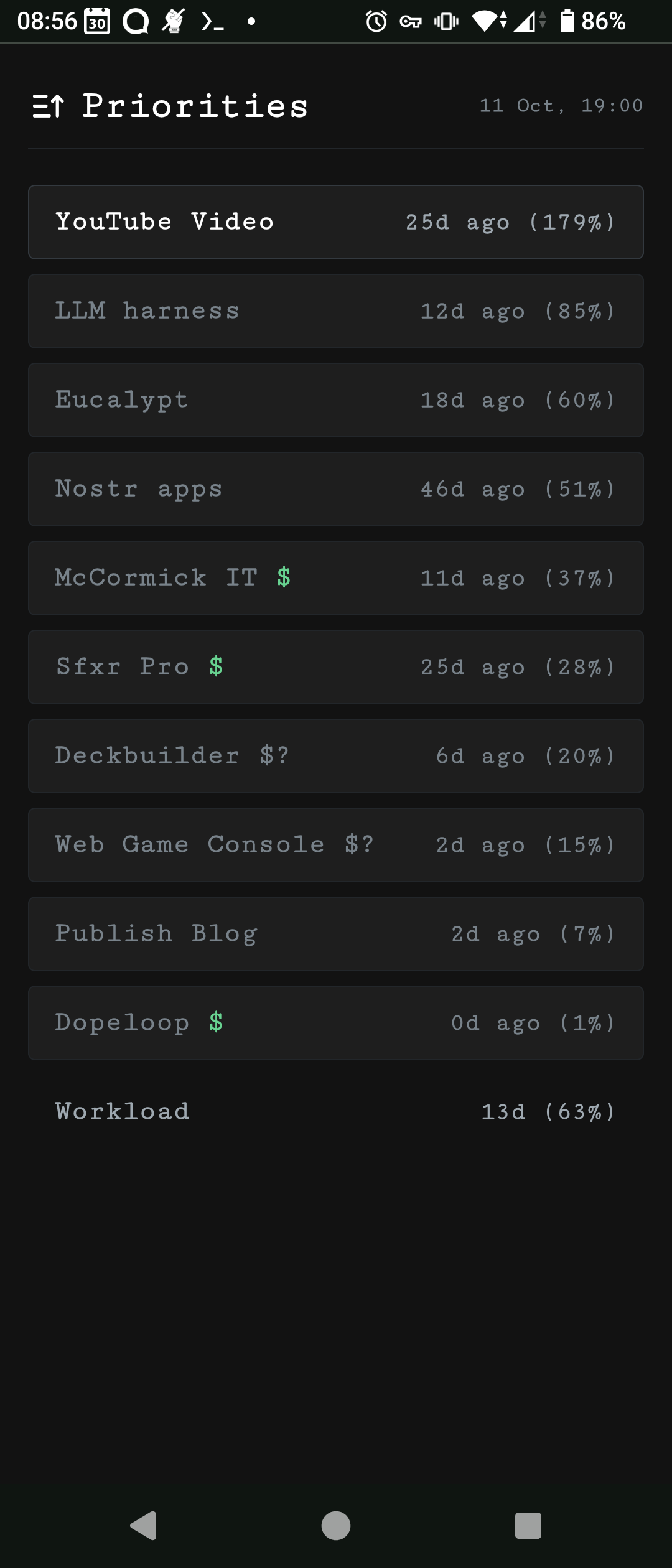
The projects are stored in a YAML file with entries for name, source, and desired frequency.
Then the script just ranks them by how overdue they are relative to the desired frequency.
The source field can point to an RSS feed (for YouTube and blog), a git working folder, or any other type of folder. It basically checks if there's anything new depending on the source type and that's how it knows something has been worked on.
For house maintenance tasks you could simply tap to mark something as "I did this today" and have it save to localStorage or whatever.
ozyschmozy 4 weeks ago | parent
xtracto 1 month ago | parent
- my blog (ghost)
- an open source recipe saas
- a web based epub reader that saves current page and other state among browsers/devices
- A multi-player mexican-train domino in rust/Yjs
- A self made app i call "auto-SaaS": postgREST+empty page+AI Agent (clippy chat animation and all) that allows me to build ANY personal saas i need:
* simple aisle based supermarket shopping list (shared with my wife)
* note taking app that auto groups notes by date
* auto-scrolling news web page that I can read while stationary cycling in my tablet (AI summarized to de-editorialize)
* a battleship game! To play with someone when bored.
Among other minor stuff.
lhoff 1 month ago | parent
You might want to have a look at pocketbase. I use it as a backend for my vibecoded "auto-SaaS" Tools.
bingo-bongo 1 month ago | parent
3x$5VPS: Garage S3 cluster for static sites and project builds, behind haproxy. Also runs Postgres w/ patroni and a small game server for a game I’m working on and some nameservers. My website is on all 3 VMs and has a little gimmick, where state is tracked between them.
3xOld MiniPC: Proxmox cluster for running Gitlab+Runners, monitoring vm, Valheim server, Syncthing, plus a couple of other odd projects. The oldest hw is probably close to 10 years old (NUC7) and the other two is refurbished Lenovo M710q I think, so nothing fancy.
Everything is connected- and communicate over Tailscale.
jrecyclebin 1 month ago | parent
dvdyzag 1 month ago | parent
lelanthran 1 month ago | parent
People underestimate just how much a $5 VPS can run, because they are using things written in Java, C#, Python, PHP, etc.
I had a $5 VPS once manage device is image downloads via HTTP, and had 100s of thousands of devices update themselves in a single night, with about 10k concurrent connections at peak.
That same instance later couldn't run a single Jenkins instance for a single project...
ahf8Aithaex7Nai 1 month ago | parent
I also run a few personal web services: Immich, Gitea, Bookstack, Jellyfin, and more. That cheap VPS couldn't handle it. I run the services on a computer in my home office. Caddy runs on the VPS with one proxy line per service. Data is, of course, exchanged via Yggdrasil. The domains for the various services all map to the VPS’s IP addresses. Caddy then handles the routing correctly. The system works simply. I can even run storage-intensive services like Jellyfin, and it only costs me a few euros for the VPS.
tommica 1 month ago | parent
Does it mean that the VPS has to be in-between all the traffic, or do we punch holes through the NAT for direct connections?
ahf8Aithaex7Nai 1 month ago | parent
The Yggdrasil client is installed on every computer. I'm running Debian. I have no idea how well it works on Mac or Windows. Yggdrasil assigns a key pair to each computer.
On the VPS, the config is modified in two places:
    Listen: [
      tcp://[::]:51350
    ]
    AllowedPublicKeys: [
      pubkey1
      pubkey2
      pubkey3
      ...
    ]
Note that this is only the config for the VPS.
I only make one change to the config of the other computers:
    Peers: [
      tcp://hub.mydomain.tld:51350
    ]
> Does it mean that the VPS has to be in-between all the traffic, or do we punch holes through the NAT for direct connections?
It depends. If the computers can reach each other on a local network, the Yggdrasil clients will automatically find each other and connect. To do this, you wouldn't have had to change anything in the default configuration. you would simply have had to install and start the Yggdrasil client on the computers.
With NAT in between, they wouldn’t connect on their own. But since they’re configured to actively connect to the hub in any case, they can still see each other via the hub and exchange data even in this scenario. Yggdrasil handles routing and NAT traversal. If both paths are available (locally or via the VPS), Yggdrasil defaults to the local path. But in the general case (where all other computers are behind NAT), all traffic would go through the VPS.
Special case: If only one of the two computers is behind NAT and you want a direct connection, then the accessible computer corresponds to the VPS in the configuration above.
reacharavindh 1 month ago | parent
ahf8Aithaex7Nai 1 month ago | parent
And I don't like it when I see the word “Pricing” on a project's website. It makes me suspicious. I can rely on gifts to the world like Linux, Debian, PostgreSQL, Apache, Nginx, Caddy, and Yggdrasil without any problems for decades. Commercial software products turn into shit sooner or later. I’m happy to pay for things, but paradoxically, software seems to be good and stay good only when it’s gifted.
I’m vaguely familiar with Tailscale from work. The licensing model restricts usage. The central control plane is closed-source. Someone built an open-source implementation. Then they hired the lead maintainer. It’s the usual business nonsense that could lead to them being bought by Google or Meta, or trying to monetize my metadata, or shoving ads down my throat, or doing something stupid with AI. I’d rather stick with Yggdrasil.
tommica 4 weeks ago | parent
tommica 1 month ago | parent
gullevek 1 month ago | parent
cpro29a 1 month ago | parent
daitangio 1 month ago | parent
Owning your email is nice, and save you sone bucks if you want family accounts.
hmyn 1 month ago | parent
ReDress 1 month ago | parent
For as the primary functionality of your local computer is as a desktop then you do indeed need to be running a server(be it a VPS, dedicated server or whatever).
Otherwise, then I would ask the question? What do you use your local computer for? Playing games? Sounds childish
The bottomline will remain, there's functionality you can get from a $5/month VPS that you can never get out of a desktop. Do I really need to list them? Probably not because they're too obvious. I mean, a server gives you access to the internet.
But, anyways, I forget servers are not useful anymore because we have all move to the AI protocol :-)
edarchis 1 month ago | parent
[edit] I listen to a bunch of audiobooks, so Audiobookshelf.org
JamesLeonis 1 month ago | parent
File sharing, BitTorrent, and version control are my mainstay applications I've run on my servers over the years. File servers are out of trauma; I've lost too much data to trust software or hardware, and servers are the easiest way to configure stuff like RAID/ZFS as well as automated backups. BitTorrent on a server lets me be a good citizen and seed consistently. Version control right now is Forgejo, and given the nonsense at Github this is becoming a better decision by the day. There are also a number of support services like PostgreSQL and NGINX, with CRON powered backups to the fileserver.
miyuru 1 month ago | parent
So I have a VPS running for thoses downloads and any that slow.
asimovDev 1 month ago | parent
dada216 1 month ago | parent
At home: truenas and gitlab.
At home, for work: I have an older HP workstation with an older Xeon with 24 physical cores and it runs a rhel (I have them for free as a partner) and I use it to run VMs for experiments and replicating infras, K8S, Windows AD stuff, etc.
alprado50 1 month ago | parent
asim 1 month ago | parent
The value of any VPS is what value it delivers in your daily life. Whether that's running your own VPN, mail server or just personal apps you build for yourself.
There was a phase where we ran lots of open source stuff. Now I think we'll just drop agents on these VMs and let them use it to build apps or browse the web.
wila 1 month ago | parent
hn_submit 1 month ago | parent
voidUpdate 1 month ago | parent
- An old desktop running alpine that hosts two minecraft servers
- Another old desktop acting as a NAS. Currently planning on migrating that to a mini lenovo pc to reduce size and unify everything. I have a single HDD that I've split into partitions for projects and Linux ISOs, currently serving over samba. It also has a transmission client on it to download the Linux ISOs. Probably the most useful box on my network
- A mini lenovo PC that runs homeassistant, and in future will probably turn into my NAS, once I can find a good storage solution for it (Not much expandability inside the box itself, but it has some usb 3 ports. Id put my existing 3.5" HDD on a usb sata adapter, but they also need 12v. Currently looking into an NVME dock or multi-terabyte laptop SSDs)
- A raspberry pi that will, in future, run my website (currently still working on the software for it)
t1ll 1 month ago | parent
Traubenfuchs 1 month ago | parent
I vibecoded a diary + life statistics/metrics web app, another one that shows me public transport I care about, etc.
Half of the fun was setting all of this up. Learning terraform, kubernetes, helm, lgtm observability stack, https, vibecoding…
I can also use this to show that I am a “total stack” A-Z developer.
ramon156 1 month ago | parent
Using this, i can expose services on my home server without giving access to the internet to probe on it. I can host an immich server and not be afraid that someone can access it
coldstartops 1 month ago | parent
lode 1 month ago | parent
- Tailscale exit nodes (I don't use them to stream Netflix or torrents over, but sometimes they're useful to browse "this content is not available in your region" sites, to use WhatsApp while transiting through Bejing airport, ...)
- Invidious
- FreshRSS.org
- Vaultwarden
- some silly scripts
I treat these as disposable and can spin them up again from daily backups if needed. So far the stability has been good as with more expensive infrastructure providers.
My home setup is not $5/month VPS but a sub $100 second hand thin client running KVM is used for: - Home Assistant
- Immich photo hosting
- Music Assistant
- Pihole
- Hister
- Invidious
Obviously the storage requirements for media and photos are higher, these go to a (more expensive) Synology NAS, and are backed up externally, but that's beyond the scope of this post. The Home Assistant + Pihole storage requirements are minimal.
elias_t 1 month ago | parent
JDSP 1 month ago | parent
prolly97 1 month ago | parent
I've opened some of the data up to the public: cvrdb.dk for danish companies (working on granting users access to 'full' extracts of certain parts). ratemyaisite.com which is just a tiny subset of a larger project that I've dubbed commoncrawl-explore (cc-explore), which is run on a subdomain of my personal website, but purely for my own sake.
Making your own devex pleasant is the real game changer imho, not the VPS. I've made it easy for myself to deploy new projects using Dokploy (also tried Coolify).
I don't find the maintenance to be a problem - but part of that is not treating hobby projects as something that has to be enterprise-ready :)
Agingcoder 1 month ago | parent
kitsune_cw 1 month ago | parent
easyThrowaway 1 month ago | parent
kidnoodle 1 month ago | parent
alg0rith 1 month ago | parent
maurits 1 month ago | parent
Way way back when, I also did it to learn a bit more about daily *nix craft.
cubesnooper 1 month ago | parent
Before using VPSes, I hosted from my home IP directly. This has serious privacy downsides: from your IP address, it’s mostly trivial to find out who you are (e.g., by seeing your IP has port 443 open and checking the domain names of your TLS certificates), and from your domain name, it’s trivial to find out where you live (by way of the ISP whose IP address your domain points to). Using a VPN for general browsing helps with the first point but not the second. There’s also the threat of DDOS (if your server gets attacked you lose access to the Internet entirely, and then you’re really in trouble). Also, residential ISPs are rare and people who need a static IP (or even a non‐CGNAT IP) are not reliably catered to; VPS companies have plenty of competition and having a publicly accessible IP address is the default.
Once I started running VPSes, I ran many services directly on the VPS. Over the years, I’ve migrated everything to physical hardware in my house (or a secure offsite location), for privacy and performance reasons. I can add as much storage and RAM as I want. Incoming connections are port‐forwarded over WireGuard to my LAN, so the VPS provider can only gather metadata from encrypted connections. Unfortunately the game servers mostly don’t support TLS; I’d prefer to hide them behind a VPN, but that would be too difficult for the players.
I actually use three VPSes, each in a different datacenter. VPS downtime (that’s not caused by me) is pretty rare, but happens periodically, and is almost entirely due to maintenance being performed in the datacenter. Email and DNS both support redundancy.
My VPSes are from different providers, too. One time an OS bug caused high CPU usage for an extended time, and the provider nearly terminated my account on suspicion of crypto mining. If a particular company ever drops me or goes out of business, I can just change a few DNS records and firewall rules and be back in business.
The vast majority of my downtime has been from power outages at home and the residential ISP going down (it's crazy how often that happens, I had no idea until I started measuring it). So I got a second residential ISP. If one route goes down, the VPSes port forward over the other, or over a third route to my offsite LAN.
Each service runs in a separate VM. Some might consider that overkill, but I like how simple it is to move VMs between hosts. Services run as unprivileged non‐root users with no ability to initiate outgoing connections.
Services for which I’m the only user stay entirely within the LAN. I do have extrnal access to the LAN, three ways: WireGuard, SSH, and HTTP proxy. The proxy is a last resort, but it’s been a lifesaver when I was stuck for a week at a conference whose wifi blocked SSH and WireGuard (in fact, everything but HTTPS and DNS).
neilmovva 1 month ago | parent
olivierduval 1 month ago | parent
- Cheap VPS is nice for electric & network reliability (mail servers, public facing website or webapp)
- local hosting is nice for price/control/internal tools (some git and maven, different tools)
nicbou 1 month ago | parent
Now the city got its act together and appointments are easy to find, but for a while it was very useful. I'm glad to say that this service is ready to be shut down.
andersonklando 1 month ago | parent
meteyor 1 month ago | parent
omgbear 1 month ago | parent
wraptile 1 month ago | parent
One for personal self-hosted projects: languagetool, nextcloud, hister, syncthing, restic backups, vaultwarden, windmill.
Another for public facing web apps I host through cloudflare tunnels. As well as public facing friend tools like jellyfin via tailscale tunnels.
Everything on nixos with config repo that configs all of my machines with claude code. Restrict claude from executing `nixos-rebuild switch` and review each change before switching manually.
xandrius 1 month ago | parent
You placed the laptop in a location where slowly but surely there is a dust build up in the fans? You get some issues.
Hard drives start degrading? You get some issues.
And so on, while I've been running some personal things off VPSs too and those never had a single second of downtime. My home machine is my pride and joy but for sure 1 day a year on average there is something. But much cheaper in terms of raw components and performance.
So, yeah, it makes sense if you want the things you run not become a side job/hobby.
wraptile 1 month ago | parent
That being said, it's really fun and claude code on nixos is excellent rn at doing all the boring grunt work while letting you remain in the "grand architect" position. Lastly, it feels really nice to have personal compute you can trust and good future investment as compute is increasing in accessibility and risk so self-hosting is really popping off right now.
xandrius 1 month ago | parent
kilroy123 1 month ago | parent
jamiepond 1 month ago | parent
CTOSian 1 month ago | parent
Nero200 1 month ago | parent
petercooper 1 month ago | parent
massysett 1 month ago | parent
You’re going to get a lot of affirmative answers here, which is maybe what you’re looking for. Maybe you’re brainstorming.
But I’ll affirm what you’ve probably been thinking all along: It’s not worth it. I set up a Lenovo ThinkCentre to be my personal Linux server running on my home network. I could use it for backups, ssh, taskwarrior, etc. It did solve some problems.
It also creates problems. The biggest is that it’s another computer to maintain. It needs updates. Critically, it needs security. You need to secure the ports and services, use vpn, etc.
I found that none of the gains were worth the maintenance. For my problem set, it’s easier to keep multiple cheap laptops in multiple locations and use a flash drive (rather than network) to move data between them.
For backups, specialized cloud services (currently Arq going to B2) does the job better, along with Carbon Copy Cloner to a local volume.
For me, having to maintain and secure it was too much work. A vps may have been easier in some ways, but harder in others.
So in the end you may be right: just run things on your laptop.
wiether 1 month ago | parent
> For me, having to maintain and secure it was too much work. A vps may have been easier in some ways, but harder in others.
Maintenance is running upgrades once a week/month -> 10mn
Depending on how critical your data is, you can rely on the provider's backup policy or setting up something as simple as a cron rsync on an external provider -> 2h to setup
tempoponet 1 month ago | parent
drnick1 1 month ago | parent
It seems like you are doing this wrong. Unattended-upgrades takes care of updates. The ports need not be "secured." Some need to be open if you are running publicly facing services like email, there is no way around it, and it's not a security problem per se. Internal services should be behind a VPN, but that is a one-time setup cost, and one that a cloud solution would also face.
guidedlight 1 month ago | parent
It’s definitely a way to get a competitive advantage over others that rely on more traditional architecture.
eternaut 1 month ago | parent
huijzer 1 month ago | parent
- fx (my own blog software)
- syncthing (sync files to remote servers for backup)
- borgbackup (store old copies of files for backup; via cron)
- radicale (calendar)
- pingvin-share-x (file sharing with other people)
- Forgejo (GitHub-like clone; using it many times a day most days)
- vaultwarden (self-hosted Bitwarden)
- immich (not really using it much)
archerx 1 month ago | parent
- a micro community that a core group of people chat on every day
Both on what used to be digital ocean $5 droplets. Once I find the time and energy I will migrate everything away from DO, the price was raised but the quality and speed of their servers stayed the same.
walrus01 1 month ago | parent
icar 1 month ago | parent
nha1 1 month ago | parent
I wrote about it a couple days ago actually https://klar.im/blog/launch-a-startup-for-15-euros-a-month
BiteCode_dev 1 month ago | parent
It's just a gtd inbox and consumes nothing, but I can just empty my mind and save my adhd brain from drifting to all those butteflies.
theodric 1 month ago | parent
SoonDong 1 month ago | parent
radu_floricica 1 month ago | parent
For starters, a VPS for each claude code project (with a simple orchestrator and project creator).
I'm also playing lowkey with small ESP32 powered automations, and having a VPS to monitor them, show a web interface and push updates. And I've just added a small REPL like module.
kristianp 1 month ago | parent
5ak3t 1 month ago | parent
robinpie 1 month ago | parent
nulbyte 1 month ago | parent
I might also have a really stupid website^H^H^H^Hpage "counting" how many hours of daylight we saved. (Hint: It's just a static page with the number 0 on it.)
PeterStuer 1 month ago | parent
edumucelli 1 month ago | parent
VonLuderitz 1 month ago | parent
sdcfgy 1 month ago | parent
Runs IRC bouncer, some scraping jobs, samba server for the family (mostly music and films), backs up our IMAP boxes (on iCloud and other providers).
stego-tech 1 month ago | parent
Right now one of them hosts the following:
* Jellyfin for my physical disc collection
* Ergo for an IRC server daemon
* A vibe-coded project that lets folks upload images and stick them to a canvas like stickers on a light pole (great for memes)
* Caddy as a reverse proxy
* Pocket-ID for passkey-auth
* LLDAP for crustier directory auth (like Jellyfin)
* FreshRSS for an RSS aggregator
* RSS-Bridge as a support
…and a smattering of in-progress projects. Honestly lamenting not grabbing a $5 Hetzner VPC when they were available so my public services could live out there, but I’m an edge case.
My advice is less to think about justifying it now, and more thinking “would I get $60/yr worth of enjoyment or utility from a VM in a real datacenter somewhere?” In that context, you’ll almost certainly get utility from that by year’s end - and if not, you’re only out the $60.
tejstead 1 month ago | parent
Also have my resume and other such projects on the server
tylerhillery 1 month ago | parent
paweladamczuk 1 month ago | parent
- Jellyfin
- Vaultwarden
- Immich
- pi agent. I use it through tmux and iSH on my iPhone
- librechat. nice UI but honestly I probably jsut use pi more often
- copyparty. to visually inspect whatever I create with pi, and to access my documents, to upload files I need on the server quickly and easily from any device
ant0ni 1 month ago | parent
pirateirl 1 month ago | parent
proxysna 1 month ago | parent
Things i use daily-ish:
- Wireguard with wg-easy to access my home network and other way around to keep services i don't want to be seen on my network away from my ISP.
- Calibre-web for my ebooks
- Forgejo/Gitea as local git server + CrowCI for my hobby projects.
- Samba server to access my things over the network.
- Trillium for note taking.
- Nomad for my other more infra related projects
ur-whale 1 month ago | parent
DNS servers
[EDIT]: wireguard node for my private VPN
haaz 1 month ago | parent
Keeping my namecheap API key on the server means every time I make a new website I just buy the domain and tell my AI agent to SSH in and set everything up.
overcast 1 month ago | parent
weberer 1 month ago | parent
I uninstalled Claude Code from my laptop after an incident where it got stuck on an issue and started scanning my home folder for resources. Its unacceptable and scary behavior, so now it gets it own machine where it can't touch my keys.
drnick1 1 month ago | parent
At the very least, you should create a separate user account, without sudo, for agents. If you do anything risky, a VM seems required.
crossroadsguy 4 weeks ago | parent
crossroadsguy 4 weeks ago | parent
letmetweakit 1 month ago | parent
Daegalus 1 month ago | parent
  Tangled Knots and Spindles
  Uptime Kuma
  Umami analytics
  Netbird
  Linklater
  Miniflux
  Seafile
  A few other small apps
erdaquin 1 month ago | parent
adityapurwa 1 month ago | parent
Disclaimer: Creator
ketzu 1 month ago | parent
  * kubernetes for learning and a lot of followup just because it enable easy deployment t9 play around witg things (argocd, openbao, uptime kuma, victoriametrics, cnpg/postgres, cloud beaver, traefik)
  * keycloak for everything that supports it or can be made to support it without patching it
  * personal website (via WordPress)
  * grafana for monitoring my side project
  * foundry to play DSA with friends
  * various small hobby stuff
  * best: paperless ngx
Minipc:
  * proxmox host
  * home assistant
  * open media vault, jelly fin for digital versions of my DVDs because it is easier than using the physical dvds
  * past: opencode/Claude dev VMs
  * Hermes to play CEO for my side project (just as an advisor, he has little actual connectivity)
  * pihole for local dns and adguard
  * Caddy for local tls
horsawlarway 1 month ago | parent
keycloak
immich
jellyfin
several personal sites
home assistant
unsloth studio
several synology tools on a nas (drive/security/backups)
etc...
If it's "just you" your laptop is likely fine. Hosted tools really start to shine when you've got a group of folks using them. Ex - Wife/Parents/Kids/Extended Family.
Simple k3s cluster and the shallow end of kubernetes actually saves you a ton of time and effort (don't go into complex orchestrators or helm charts - just write small deployments in static yaml). You can get to roughly the same spot with just docker/compose if you want, but the capabilities cap out earlier (ex - multi-machine, resilient to any one machine going down, gpu sharding, etc)
Maintenance is basically "sudo pacman -Syyu" on a cron job.
_nhh 1 month ago | parent
itintheory 1 month ago | parent
xujizhong 1 month ago | parent
AMD_DRIVERS 1 month ago | parent
whitef0x 1 month ago | parent
floydnoel 1 month ago | parent
mrngld 1 month ago | parent
People have commented a lot already, but one thing I do that I haven't seen others already doing yet is I run a news summarization pipeline with Miniflux and Flatnotes.
All my feeds are in one of two categories; Summarize and NoSummarize. Once a day, a script fires at everything unread in the Summarize category, pulls the full text from Miniflux (or calls a scraping service if it appears to only have an article stub), groups similar articles to together with a 60 to 80 word summary, and for everything not grouped together it gives each article a 20 word or so summary. Just enough for me to know if it warrants a full read or not. Then it takes that a posts the digest to a markdown file in a Flatnotes folder. Flatnotes I expose via Tailscale Funnel so I can read it anywhere, including on my work laptop if I'm at the office.
Why Miniflux and Flatnotes and not other options? Mostly because those two are about as lightweight as it gets with still pleasing interfaces and basic features.
layer8 1 month ago | parent
tryauuum 1 month ago | parent
- vpn exit node
- personal email server
ahmetozer 1 month ago | parent
nunodonato 1 month ago | parent
throw7 1 month ago | parent
Secondary was for bittorent'ing.
elAhmo 1 month ago | parent
bushido 1 month ago | parent
I think it's saving me about $8 to $10 a day that I was previously spending on GH Actions.
VERY worth it.
rgbrgb 1 month ago | parent
- family ai knowledge / data store MCP https://setoku.com/
I love interserver.net which starts at $3/mo and has much better network and cpu than providers with twice the specs. I benchmarked a bunch for a hobby project. I also run some professional stuff there (worker servers for https://hedgy.works). Also LAX locations with great ping in California.
BTW I do think this is a golden age for the humble VPS. If you’re daring you can totally let Claude code be your sysadmin.
nepthar 1 month ago | parent
trollbridge 1 month ago | parent
It’s simply more cost effective to run your own micro data centre once you have enough workloads. I suppose if you have absolutely no office anywhere and don’t need office Internet, electric, etc. then it’s worth it.
sloum 1 month ago | parent
andai 1 month ago | parent
https://spacefightinggame.com/
I picked a dumb name though, open to suggestions!
nickpsecurity 1 month ago | parent
I'm also using BunnyCDN right now.
totetsu 1 month ago | parent
realty_geek 1 month ago | parent
droobles 1 month ago | parent
dbmikus 1 month ago | parent
I have a media server I run on a spare desktop, and at one point was messing around with https://syncthing.net/ for a self-hosted form of Dropbox. More recently, I'm using a VPS to run some internet scraping jobs for things I want to monitor, like apartment listings in NYC (where I live).
Of course, I also use this to run long-running cloud coding agents! Basically exactly what DHH's AI shed is. You need something stronger than $5-$10 / month VPS. I connect with https://herdr.dev/ for persistence
Because of how relevant the "AI shed" concept is, I would be remiss to mention my startup: https://www.amika.dev/
Amika lets you turn any computer into an always-on, network-connectable, AI shed. It's not ready for primetime quite yet (beta launching soon), but I use it for all my dev work
It's partially open source, which is here: https://github.com/gofixpoint/amika
znpy 1 month ago | parent
Also, over there, i run my monitoring stack (prometheus+grafana etc) since it's the most stable part of my infra in terms of networking and power supply).
modeless 1 month ago | parent
dpedu 1 month ago | parent
josefresco 1 month ago | parent
Jellyfin, Tailscale (to route my Internet when I'm travelling), and 3-4 web app side projects.
While I've considered a VPS for true 24/7 access (and more power), I haven't yet built something critical enough to justify the cost.
Also, Tailscale on a VPS wouldn't serve my travelling needs which are to use my home connection/IP/geo.
krypdoh 1 month ago | parent
billfor 1 month ago | parent
tonymet 1 month ago | parent
navan 1 month ago | parent
lkramer 1 month ago | parent
I do pay a little more, 16 euros per month, but this is largely to have 1TB of space.
I have had my own VPS since around 2010. Before that I was running an old Sun machine as a home server, but it was so heavy and unwieldy I gave it away when I moved.
Semaphor 1 month ago | parent
Living room has a small passively cooled n150 which runs almost 20 services, from home assistant and jellyfin, over paperless and navidrome, to some lesser known services (yamtrack, koito, grimoire). A bunch more, and I use them regularly, some more than others, but then adding a service without exposing it (my caddy lxc has 2 IPs, one port forwarded one internal only) is really cheap.
moralestapia 1 month ago | parent
kps 1 month ago | parent
kraptv 1 month ago | parent
It was previously running on a $25 VPS and we made a number of optimizations/enhancements and it's in a happy place now.
deniska 1 month ago | parent
- irssi running in screen (irc client, yes, occasionally I still talk to people on there)
- my very small imgur-inspired image hosting (https://github.com/deniska/imghost)
- miniflux (RSS client, I am trying to get into a habit of reading RSS feeds instead of letting the algorithm to decide what I read)
- git directory with bare repos I use as remotes over ssh. I also have gitea installed, but I don't really see the appeal if I'm the sole user of a repo.
- snikket, xmpp server with a whatsapp-esque mobile app, useful to talk to people who are behind the great Russian firewall
- llama.cpp serving gemma4-26b-a4b for image processing of things too sensitive to let openai and other similar companies to see it (ok, this on won't fit on a $10 vps)
- minecraft server for this once a year 2-week minecraft phase
de4ddne3 1 month ago | parent
sixdimensional 1 month ago | parent
csharpminor 1 month ago | parent
I have the Codex Linux desktop app running on there and quite enjoy building games on my TV with my kids. We just dictate silly ideas via my phone and codex builds them for us.
tombert 1 month ago | parent
I use it mostly to host a Minecraft server and to host a dumb website I vibe coded to share 3D Movie Maker movies. https://showbo.at/
ETA:
Looking at downstream comments, it looks like it's limited to 12 gigs and 2 cores now. Still a pretty good deal for free but not quite as good as it used to be.
j027 1 month ago | parent
https://docs.oracle.com/en-us/iaas/Content/FreeTier/freetier...
fransje26 1 month ago | parent
tombert 1 month ago | parent
fransje26 1 month ago | parent
tombert 1 month ago | parent
    ubuntu@instance-20250824-2334:~$ free -mh
                   total        used        free      shared  buff/cach  available
    Mem:            23Gi       3.5Gi       768Mi       7.7Gi        19Gi        11Gi
    Swap:             0B          0B          0B
kiddico 1 month ago | parent
richwater 1 month ago | parent
tombert 1 month ago | parent
rstat1 1 month ago | parent
tombert 1 month ago | parent
That’s actually how I have it set up because they kept running out of capacity in the credit-card-less account and someone on Reddit mentioned that loophole.
crossroadsguy 1 month ago | parent
j027 3 weeks ago | parent
It used to be 4 cores and 24GB RAM in the past for at least 4 or 5 years but it recently changed.
j027 3 weeks ago | parent
crossroadsguy 1 month ago | parent
elendilm 1 month ago | parent
Have used them for years. I don't use them anymore but that is because I no longer have a requirement.
broots144 1 month ago | parent
vardalab 1 month ago | parent
test6554 1 month ago | parent
filcuk 1 month ago | parent
test6554 1 month ago | parent
Also it's going to stay up even if my house catches fire which is something.
whalesalad 1 month ago | parent
Matrix/XMPP server for self-hosted federated chat.
v3ai 1 month ago | parent
K0IN 1 month ago | parent
porkphish 1 month ago | parent
eric15342335 1 month ago | parent
bccdee 1 month ago | parent
I often need to copy a sensitive string from one computer to another, and I don't want to worry about it getting preserved in the edit history of a Google Doc or whatever. A small pastebin service with basic authentication where deleted notes are deleted permanently. I use it all the time.
smccabe0 1 month ago | parent
nharziro 1 month ago | parent
ignatif 1 month ago | parent
ChucklsTheBeard 1 month ago | parent
MayeulC 1 month ago | parent
The VPS is useful for:
- sending e-mails (hard to improve your reputation on residential IPs and get a reverse DNS record)
- Unifi controller, though I appreciate Unifi less and less.
- Uptime monitoring / status page
- I think I'll move my headscale node there, since it has the highest availability -- Internet was out for a week last month, which is exceptional, but rarer in a DC
- backup Internet connection (especially incoming packets, as it's hard to port forward on mobile Internet).
- netdata for monitoring
Now, I use my servers a lot more:
- HomeAssistant on all of them
- power monitoring to warn of power cuts when not at home (freezers!)
- netdata
- yggdrasil
And for the one beefier instance:
- esphome
- Wireguard links between it and all nodes/VPS, plus a few devices -- I like Wireguard, but Tailscale is much easier to manage for full mesh and just adding personal devices.
- jellfin, *arr and torrents
- calibre web (mostly humble bundle DRM-free books, actually)
- e-mails (receive, I should make it more redundant though)
- Matrix server (synapse). For years this was the most resource intensive service. It's much better now. I do not recommend due to spam waves.
- headscale
- Nextcloud, OnlyOffice, Kanboard: for productivity
- Prometheus, grafana & monitorix: monitoring, plus netdata aggregating data from other nodes
- Open Sondage, Framadate, I hate money: for friend groups
- Vaultwarden: password storage
- Wallabag (should use it more or may retire soon)
- Ntfy: for UnifiedPush
- LDAP server: for centralized auth
- Borg backup
- Some custom web apps and probably more I forgot
Services I plan to host soon: Garage (S3), split across nodes, Ente (currently using the hosted version)
Services I retired or only start on demand: Funkwhale, Peertube, ampache, overleaf, ethercalc & etherpad (both had too high CPU use on idle, not worth 5-10W). At some point I had game servers behind systemd socket activation to only turn them on on-demand.
Yunohost is pretty good for starting, but it's quite amateurish, I prefer declarative configs and containerization these days.
I also think pretty hard about ways to get my power usage down (around 30-40 W on my main, next upgrade should bring it to 25), so I'm monitoring the usage and correlating to power use (via a smart plug). I wish there were more turn-key solutions for putting nodes to sleep in kubernetes & others, I'll likely investigate this at some point. Tiered storage systems also tends to focus on perf, not power efficiency.
And yes, I'm considering moving more things behind tailscale to reduce the attack surface. Some containers listen to localhost and I use ssh -D to access them, but tailscale would be more convenient.
basscomm 1 month ago | parent
racl101 1 month ago | parent
PaulHoule 1 month ago | parent
I haven't had an actual server, VPS or cloud instance running full time since about that time. Everything I have outside the house is built on serverless tech such as AWS Lambda.
ndr 1 month ago | parent
One of them is something I've been hacking on recently: hnfollow.com
But have a whole lot of small services that I run for friends and family too.
runamuck 1 month ago | parent
thln666 1 month ago | parent
gbuk2013 1 month ago | parent
wmedrano 1 month ago | parent
ryzmdotdev 1 month ago | parent
zexias 1 month ago | parent
Havoc 1 month ago | parent
So the 2 buck one is just stuff I want on a freestanding IP/system or where it absolutely can't be CF protected / tunneled. e.g. https://tls.obsidian.place - TLS info tool...has to be raw exposed server to work.
hebetude 1 month ago | parent
shpyrd-founders 4 weeks ago | parent
PS: I founded a company called shpyrd (https://shpyrd.io), its very good for putting AI agents and sites/app made by Claude/Codex directly online.
MPSimmons 4 weeks ago | parent
Ey7NFZ3P0nzAe 4 weeks ago | parent
commandersaki 4 weeks ago | parent
beardedtechguy 4 weeks ago | parent
factorialboy 4 weeks ago | parent
* Podcast subscriptions and syncs (queue, playtime)
* Ditto for YouTube
* Self-made and self-played online web game
coniu 3 weeks ago | parent
whiten-baiye 3 weeks ago | parent