40 points gliffie 1 hour ago 20 comments
smartmic 1 hour ago | parent
jcranmer 1 hour ago | parent
krunck 59 minutes ago | parent
layer8 57 minutes ago | parent
In the very far future, leap seconds would become inadequate anyway, as you’d have to insert them every month, then every week, then every day, due to the deceleration of Earth’s rotation.
hnuser123456 50 minutes ago | parent
Sure, you could also run a relativistic simulation of the solar system, galaxy, and cosmos to establish a more monotonic clock and calendar independent of imperfect orbital parameters, but that's a bit much for discerning whether or not it's lunchtime.
wahern 30 minutes ago | parent
Barycentric Coordinate Time: https://en.wikipedia.org/wiki/Barycentric_Coordinate_Time
layer8 59 minutes ago | parent
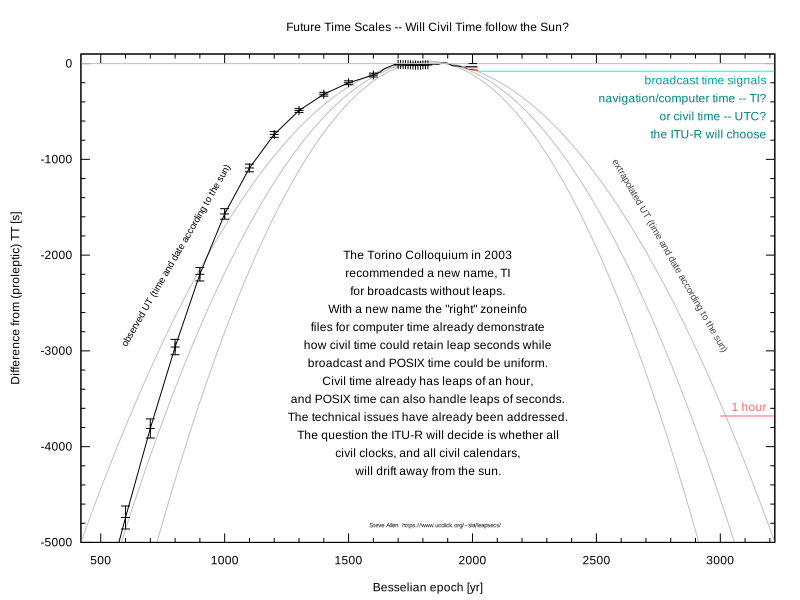
throw0101c 20 minutes ago | parent
Which doesn't seem like that is soon, but time/calendar issues can creep up and then it's a big hullabaloo:
throw0101c 25 minutes ago | parent
People have a hard time with leap years, which happen regularly every four years, so I'm curious to know how well a "one-off" event at a basically random time in the future will work.
frangonf 1 hour ago | parent
basilikum 5 minutes ago | parent
hnuser123456 55 minutes ago | parent
BoppreH 50 minutes ago | parent
The page lists several good reasons for this, including:
- It's a common source of bugs.
- IoT, embedded systems, and anything that cannot receive time updates have trouble with leap seconds.
- Negative leap seconds have never occurred before, but might occur in the future, and almost no software has tested this case.
I'd also add:
- Unix timestamps are actually defined as "seconds since epoch minus however many leap seconds have happened". It's a hack to make the keep code that assumes 86400 seconds in a day from breaking. It means that during a leap second the Unix timestamp goes back and repeats a previous value, making them ambiguous and non-monotonic.
- Leap second unpredictability can make it impossible to calculate how many seconds are between two UTC dates or Unix timestamps, for example the countdown to the year 2038 bug.
@dan: can we rename this to "BIPM decides to stop adding leap seconds to UTC" or something similar? This title is really downplaying the situation, I think readers over here care a lot about this.
layer8 46 minutes ago | parent
I don’t see that reason listed on the page, and future wall-clock times remain unpredictable due to changes in time zone rules.
What will become predictable is the relationship between posix time and elapsed time (in the sense of TAI), at least within the next few hundred years.
BoppreH 39 minutes ago | parent
likpok 41 minutes ago | parent
@-tags like this don't do anything, you're better off sending an email. I think hn@ycombinator.com is the address.
BoppreH 38 minutes ago | parent
throw0101c 32 minutes ago | parent
FreeBSD tests stuff like this for the code that they take care of:
* https://lists.freebsd.org/pipermail/freebsd-stable/2020-Nove...
Third-party stuff (like from Ports) is another question.
gliffie 25 minutes ago | parent
BoppreH 17 minutes ago | parent
On a side note, I really like how the site laid the reasoning. I'll be copying it to my technical writing.