353 points the-mitr 2 hours ago 323 comments
toomuchtodo 2 hours ago | parent
Only 13% of companies see real returns from AI, survey finds - https://news.ycombinator.com/item?id=50207881 - October 2026
FrustratedMonky 2 hours ago | parent
is this 13% of leprechauns become elves?
drivebyhooting 2 hours ago | parent
No Signs of Tech Payoff Outside the Tech Sector. Manufacturing, basic science, education, etc languished while Big Tech reaped record profits and achieved stock heights for the last 15 years.
repeekad 2 hours ago | parent
drivebyhooting 2 hours ago | parent
There are too many confounders.
to11mtm 1 hour ago | parent
Even last week I had a case where, I was reviewing code that I know the dev was vibe coding, and honestly was good up to that review.
Buuuuuut, for the stuff I reviewed that day, there was some base-class inheritance use that was so ugly that my initial teams message to the dev was along the lines of 'What crack was Copilot smoking on that one'.
Turns out, they had asked some other random-ish questions in the chat they were doing their actual work in, and those questions more or less polluted the context.
Sure, I was able to guide them for how to not do that in future (i.e. keep unrelated questions around the work in question to a separate chat, etc.) but this was also a dev that is normally both very good, but also overworked semi-related to the general 'AI will save us on dev costs thing'.
I can't help but ask whether, for the even less-technical people that are told 'yeah you lost two colleagues but here is Copilot/Claude/etc' and they don't even get enough advice to have it actually increase productivity versus chasing down gremlins in the actual work.
theteapot 1 hour ago | parent
bigbuppo 2 hours ago | parent
luckylion 2 hours ago | parent
I don't follow.
drivebyhooting 1 hour ago | parent
Doubtlessly Chinese manufacturing benefited tremendously from those advancements. But my point is the headline whinging about AI in America would also apply to Tech in America.
IshKebab 2 hours ago | parent
It'll probably be a couple of years before most companies even realise it's an option.
repeekad 2 hours ago | parent
> before most companies even realize it's an option Couldn't be further from the truth
stonogo 2 hours ago | parent
lisplist 1 hour ago | parent
stonogo 46 minutes ago | parent
IshKebab 27 minutes ago | parent
How long have people been warning about global warming? Do you still think it isn't real?
tempest_ 2 hours ago | parent
Most developers don't work building low level high performance scalable systems for a large tech firms, they are making CRUD back-ends for phone apps.
This section of the industry is definitely contracting. Even more obvious is the dev tooling part of it. Dev tooling companies are disappearing or being "bought" all over the place because what might have been a product before is now an hour or two with someone with CC.
to11mtm 1 hour ago | parent
Yeah, 100%. Even for relatively complex scenarios (i.e. over-engineered for purpose) as long as the engineer can prompt coherently and tweak it's a big increase in productivity, at least for those people.
The gap is in things like contract houses where you might see better code on code review from the people submitting but if you actually use the tools, you know that the hours billed are even more inflated than they might have been before.
Barrin92 1 hour ago | parent
the mythical man month lesson holds for CRUD apps as well. I'd be careful to equate churning out lines of code with the health of a piece of software down the road, even a relatively straight forward one.
Keep in mind in any real world software what matters is maintenance of a system, not just how many features you can add, regardless of human or machine generated code, some badly glued together codebase that's rapidly growing is going to haunt you.
Which is also why replacing sound dev tooling and with a magical prompt genie is incredibly irresponsible and short-sighted. You could cheaply produce code by outsourcing it years ago.
asadotzler 1 hour ago | parent
If you moved the goal posts any farther, they'd have traveled around the world and would be sitting at your back right now.
jstanley 2 hours ago | parent
oa335 2 hours ago | parent
It took decades for effects of personal computing to show up in aggregate statistics.
See:
https://en.wikipedia.org/wiki/Productivity_paradox and https://dl.acm.org/doi/10.1145/163298.163309
edit: My comment is not exactly right, its more about general computing rather than personal computing
marcelo-earth 2 hours ago | parent
The decade ahead is going to be a very interesting one
thereader12 1 hour ago | parent
agumonkey 42 minutes ago | parent
msabalau 34 minutes ago | parent
It's just that in 1987. the computers were generally and for the most part, irrelevant to productivity, just like steam and electricity were a promising gimmick for a long time before.. they weren't.
Looking backwards, it is easy to miss this.
agumonkey 19 minutes ago | parent
oa335 26 minutes ago | parent
gyre007 2 hours ago | parent
tracerbulletx 2 hours ago | parent
ambicapter 1 hour ago | parent
loeg 1 hour ago | parent
aDyslecticCrow 45 minutes ago | parent
datsci_est_2015 4 minutes ago | parent
password54321 1 hour ago | parent
Yeah, it is not going to be slow. Progress compounds, everything is being built on top of fast computers and fast widespread internet connection. You are not at the beginning of the curve like you were in the 20th century when people didn't even know how to use a keyboard and we are already seeing widespread disruption in security.
tracerbulletx 1 hour ago | parent
password54321 1 hour ago | parent
ForHackernews 25 minutes ago | parent
benatkin 1 hour ago | parent
williamtrask 1 hour ago | parent
Note: on an exponential, you can always say this. People will look back on today with the same "aww cute" eyes.
ben_w 1 hour ago | parent
I expect to be surprised by specific headlines, but I don't expect "software engineer" to be any more common a job opening than "steam locomotive engineer" in 10 years time.
Conversely, I would be very surprised if the robotics startups turn out to have solved general-purpose AI models that work in the real world, both fast enough and cheap enough (currecy or joules) to be significantly labour-displacing in 10 years.
Where I'm about 50-50 on which of "AI does it" or "AI does't do it" is more surprising, is specific physics research from AI. LLMs can do a lot of hard maths, there's lots of open problems in physics due to hard maths questions. So:
Consider the Alcubierre metric. The original is impossible. Can an LLM either design something in the same broad category which is physically instantiable but still useful (e.g. "yes it's sub-light but it manages 0.01c and you weren't getting that otherwise"), or prove this is impossible when limited to matter made from normal electrons, protons, and neutrons?
card_zero 1 hour ago | parent
aDyslecticCrow 48 minutes ago | parent
nicoburns 1 hour ago | parent
ijustlovemath 2 hours ago | parent
doctorpangloss 1 hour ago | parent
but have you looked up who invented the computer? and who was funding all the first versions of the software we use? it was the US military.
KellyCriterion 1 hour ago | parent
olalonde 1 hour ago | parent
emp17344 1 hour ago | parent
olalonde 36 minutes ago | parent
CuriouslyC 34 minutes ago | parent
Dario explained it very clearly in an older interview. If every model is bigger and more expensive to train, each model can individually be profitable, while the company as a whole still shows a loss at any given point in time. This is why he likes the idea of regulation so much, it'll let them take a breather and recoup.
doctorpangloss 7 minutes ago | parent
jerf 1 hour ago | parent
The question is really about the fate of the current build out. For those of us who have extensive experience with AI, which is to say, those of us here, because we are probably the only people not only using it day in and day out but potentially using multiple sessions of it all the time, I think it's not so surprising that it isn't necessarily immediately radically transforming every industry everywhere. Even as it has rewritten the minute-by-minute process of doing my job entirely, it hasn't actually changed my job all that much at the higher level and it's hard to assign much more than a 2x or a 2.5x overall improvement to it once I account for all the Amdahl's Law issues that come up from the parts that have not been so amenable to acceleration.
And without unit testing, continuous integration testing, pull request review, the fact that the AI is building code which is itself a highly reviewable artifact rather than just doing whatever directly, and all the many many guard rails we've built up in our industry that happen to be extraordinarily amenable to use by automated systems, I still wouldn't trust AI all that much for a real task. They still bang into those guard rails a lot, and still make what I consider to be deeply suboptimal decisions far too often to take my hands off the wheel. With all the stuff we have in the programming space they are a game changer, but in a field that doesn't have anywhere near that much padding and safety nets I'd be way, way more hesitant.
I want to say it's weird to talk about such things when they are also capable of such amazing math proofs, but at the same time when you consider the numbers tossed around for how much those things have cost, I think you're seeing another space that has guard rails comparable to software engineering. By contrast to the way these AIs are working, when a human solves a comparably hard problem the human tries a few things but from the outside would seem to proceed almost directly to the solution, compared to the staggering amount of blundering about the AIs do before arriving at their solutions. Now, in terms of the final results, yeah, they got there and I won't deny that. I'm just saying that in fields where the acceptance criteria are nowhere near as sharp as math or software, they're operating at a significant disadvantage still.
paimapi 1 hour ago | parent
I don't think that translates well for other fields at all. You can throw an engineer or an MBA-brained exec at a business problem all you want but until they start using the products, they're not going to be effective at guiding its development.
throw765392 1 hour ago | parent
The biggest paradigm shift has been representing models as humans, and I don’t think that’ll fade. I highly expect the AI Model T Ford will be a generalized assistant that actually works. Likely developed by OpenAI or Anthropic. And likely 5 years from now or more.
kaffekaka 41 minutes ago | parent
aDyslecticCrow 27 minutes ago | parent
Maths i a cool benchmark, but has the similar benefit to software; very easy to verify.
mr_toad 1 hour ago | parent
Computers and the internet didn’t radically change every industry everywhere. But every industry everywhere uses computers and the internet, and more pertinently, they pay good money for it.
AI doesn’t need to transform the world, it just needs to pay off the sizeable investments in data centers.
aDyslecticCrow 32 minutes ago | parent
Cause at the current rate and scope of data center investments; they have to transform the world more than... every other software system we've come up with until this points combined; to justify their cost.
yoz-y 25 minutes ago | parent
nico 24 minutes ago | parent
I wonder if you might be conflating LLM/Agent with AI
Waymo is AI, I personally would happily ride one, or a Zoox. Those are quite real tasks the AIs are performing, people put their lives on the hands of these AIs
A lot of AI models every day work to provide search results, driving directions, image recognition, automatic routing and classification (eg. Fruit packaging companies use vision models to accept/reject fruit for packaging in real time - that’s the fruit we buy at the supermarket and then eat at home), and so many other things
So inadvertently, and without much choice either, you probably already rely and depend on AI on your everyday life
ForHackernews 1 hour ago | parent
watwut 1 hour ago | parent
besterman23 1 hour ago | parent
The first requires a fundamental shift in not only how you work but expensive and complex infrastructure changes from the company itself just to make it possible (the first Mac for example would cost about $7000 per person in today’s money and would be outdated in maybe a year or two), an office building of The latter requires asking a subscription service to do a task for you on basically any computer connected to the internet.
computomatic 1 hour ago | parent
Claude subscriptions help, but only if I come in with the expertise to build the entire system around the model and I don’t mind the whole thing grinding to a halt when my session limit is saturated. Anyone selling the system off the shelf is going to be charging API rates. Computers were cheap in comparison.
besterman23 1 hour ago | parent
Perhaps they’re all on the $20/m plan which is useless?
throw765392 1 hour ago | parent
computomatic 58 minutes ago | parent
kaffekaka 48 minutes ago | parent
besterman23 44 minutes ago | parent
LLMs are great and definitely make you more productive, for some reason 493/500 firms haven’t been able to figure that out even though it’s trivially easy to provide employees with frontier models and it’s also trivially easy to use frontier models.
Which is why I say comparing it to personal computers in 1987 is not an apt comparison. That took redefining physical workspaces, new infrastructure, and new personnel which wasn’t easy to come by. Becoming a company that uses AI is just as easy (if not easier) as using any other SaaS.
kaffekaka 54 minutes ago | parent
sumeno 1 hour ago | parent
WillAdams 1 hour ago | parent
I once participated in a project where we worked up a database-driven typesetting system for a company whose annual publication had a staff of a dozen (3 managers (one of whom mostly did ad sales), 3 full-time compositors, 6 part-time) and when we put in the system they quit paying their expensive annual license for maintenance on the proprietary composition system, and fired two managers and 1 compositor and half the part-timers.
The staff was commensurately larger when they switched to the first electronic composition system they were using from the typesetter and paste-up they initially used.
jmalicki 56 minutes ago | parent
That's one of the "everywheres" the author of the statement was talking about, which is the point - you could see every part of the economy seemingly improved, but it did not show up at the macroeconomic measurement level.
It was until the 2000s that computers caused an uptick in measured productivity at the GDP level, though.
WillAdams 23 minutes ago | parent
Admittedly part of that is caused by the change in tax laws making it untenable for publishers to maintain a backlist.
taormina 2 hours ago | parent
dingaling911 2 hours ago | parent
People are, on average, too stupid to make good use of AI to the point where you can actually gain massive productivity.
The pointy haired bosses are going to do their usual approach: force people to work more, claim success, move on.
zapataband1 2 hours ago | parent
realusername 2 hours ago | parent
trilogic 2 hours ago | parent
nearlyepic 2 hours ago | parent
trilogic 1 hour ago | parent
robotpepi 1 hour ago | parent
That you don't know. Nobody knows what AI is going to be capable of in 2 years. It could continue improving, or not. There's no strong evidence in any direction. You're just ignoring what doesn't fit your narrative.
nearlyepic 1 hour ago | parent
when you say "Many will fall for the road to be paved", you are saying your idea is more important than human fucking lives. this is a recurring theme in every fascist regime throughout human history.
TFNA 1 hour ago | parent
Of course there have been regimes throughout human history that were unfree, even brutal, but no need to apply a term so linked to specific early twentieth century developments.
customguy 2 hours ago | parent
seriously though: nothing will stop the sky from being blue, anytime soon. How I know this? Because we don't constantly talk about how the sky will always be blue. If you got the goods, you don't need the sales pitch.
thatguy00 2 hours ago | parent
trilogic 1 hour ago | parent
thatguy00 1 hour ago | parent
necovek 1 hour ago | parent
tapoxi 2 hours ago | parent
Other industries don't, so they have no way of knowing if the AI is bullshitting them outside of manual validation, which makes it more expensive and slower than doing it yourself.
flowerlad 1 hour ago | parent
That hasn’t stopped Tesla. Their self-driving cars work by connecting the car’s controls directly to a neural network.
EA-3167 1 hour ago | parent
IncreasePosts 1 hour ago | parent
SonOfKyuss 48 minutes ago | parent
mr_toad 39 minutes ago | parent
flowerlad 36 minutes ago | parent
aDyslecticCrow 10 minutes ago | parent
aDyslecticCrow 8 minutes ago | parent
Madmallard 1 hour ago | parent
and if they did for your system, then it's so simple that whether or not you used AI doesn't even really matter
verdverm 1 hour ago | parent
mr_toad 41 minutes ago | parent
Back testing, hold-out sets, cross validation.
This has all happened before.
agumonkey 35 minutes ago | parent
    - fixing regular computers issues (confusing browser or os behavior)
    - finding more possibilities with your current programs (around 2020 someone once asked me if I knew a way to capitalize a word on a computer, when she realized there was a dedicated shortcut she became ecstatic)
    - having a rubberduck to discuss your daily work dead-ends
    - thus decoupling from team friction as you need to ask less questions to people that might hurt you.
secabeen 2 hours ago | parent
You can see a similar history with electrification. A few industries went quickly, but then it took like a decade of little growth before the true benefits showed up. As an example, take a factory that was built around hyrdo-power like a grain mill. You can't just take an electric motor and drop it in in place of the water wheel. It doesn't fit, the wheel is outside, there isn't room between the mill and the wall, etc. Only when you completely rebuild a new mill building designed around the features and limitations of the electric motor do you see the major benefits.
Same thing here; it will be new factories and new companies that are designed from the ground up around AI and its benefits and limitations that really move the needle.
zapataband1 1 hour ago | parent
AIs don't just make code they make words, images, and sounds. Hasn't worked in those markets either.
za_creature 1 hour ago | parent
Joke's on them, all intellectual work is modelling to some degree, and can be automated in the exact same way with the exact same mediocre results. How long until someone vibe codes a Lean for structural engineering?
electriclove 1 hour ago | parent
nemomarx 1 hour ago | parent
Very possibly on the way but so less uptake than software engineering for sure.
electriclove 32 minutes ago | parent
platevoltage 15 minutes ago | parent
AnotherGoodName 1 hour ago | parent
AI could probably write decently if every scraped book had all the revisions to create it embedded within or art had every brush stroke documented. As it stands programming is the first to be trained. The rest will take some more time.
Zigurd 1 hour ago | parent
Software creation tools have been worked on for decades to keep fallible human coders out of trouble as much as possible. Starting with compilers that enforce or at least encourage coding style humans can understand. Compilers embody formal definitions of language syntax. Lint and other static analysis technologies contribute by identifying problematic patterns in code. Leak detectors identify memory management problems. Profilers identify performance problems.
Few other endeavors have this much tooling that serendipitously happens to help help LLM-based agents be more useful and less error prone.
A lot of discussion around AI is very high-level and abstract. It helps to dig in and identify the characteristics that actually make a domain more or less amenable to being boosted by AI.
ChrisMarshallNY 1 hour ago | parent
This morning, I was talking to a friend of mine, who is a marketing (not tech) guy, and he was gushing about LLMs.
He loves being able to just dump in a bucket of seemingly unrelated data, and getting actionable BI from it.
I think we're in for a wild ride. Fasten your seat belt, and keep your hands inside the vehicle...
ToucanLoucan 1 hour ago | parent
* what he perceives to be actionable BI.
ChrisMarshallNY 1 hour ago | parent
malfist 1 hour ago | parent
emp17344 1 hour ago | parent
ChrisMarshallNY 1 hour ago | parent
emp17344 1 hour ago | parent
ChrisMarshallNY 56 minutes ago | parent
Some time ago, I had a discussion here, where I mentioned that the average commute time from the suburban community in which I live, to downtown Manhattan, was generally 90 minutes to two and a half hours.
This was based on purely anecdotal data. That data includes the daily news on the radio and TV, which considers commutes from suburbs, important enough to dedicate significant airtime.
It was attacked, because some organization published some statistics, that said the average suburban commute time was 27 minutes. I was told that I was exaggerating, and being overly negative.
Here's a math word problem:
Harry lives 25 miles, as the crow flies, from his destination. However, the roads make it 40 miles.
Of those roads, 10 miles are suburban side roads that Harry needs to take, to get to the highway. The average speed is 25 MpH.
Once Harry hits the highway, though, the real fun begins. It's stop-and-go traffic (20MpH) for 28 miles. Once he gets to the city, he needs to navigate another 2 miles, through the most God-awful traffic on Earth, to where he needs to drive around for up to a half hour, looking for a parking space.
How does Harry make the drive in 27 minutes?
A fairly significant number of folks just took that ridiculous statistic, and were quite comfortable, calling me a liar, based on it. It was kind of jaw-dropping; considering the types of folks that we have, here.
That sounds a bit more "cultish" than we might be comfortable acknowledging.
> "Lies, damn lies, and statistics."
-Mark Twain
thwarted 33 minutes ago | parent
While I don't disagree that we generally get too hung up on data, "It's a problem when the data matches the hypothesis" is an odd blanket interpretation of the scientific method.
tayo42 31 minutes ago | parent
GolfPopper 8 minutes ago | parent
Hate marketing BS and wealth extraction? Absolutely.
I see OpenAI, Anthropic, etc (the whole LLM-hype/boom) leaning far more towards being the latter than the former, in which context the dislike makes perfect sense.
paulddraper 1 hour ago | parent
rustystump 1 hour ago | parent
We got a new a CNC machine and everyone is carving away marveling at how easily it chips away at metal when the result is a jagged mess.
echelon 1 hour ago | parent
Kidding of course. It could be that he's an expert in his domain and can quickly ascertain whether the results are quality. It may also save a lot of time and be the best modern heuristic process.
I certainly will never need to write code anymore, and I can judge the output of these agentic processes. Same thing.
Zigurd 1 hour ago | parent
But those are the kinds of estimates that I can eyeball and be more than 80% certain they are plausible. That won't cut it in a lot of domains.
pjc50 1 hour ago | parent
Now, Excel also makes mistakes while trying to get clever - remember the biologists who had to rename several genes to prevent Excel treating them as dates - but it's also a ubiquitous business tool. And you can combine them. But equally Excel hasn't replaced every white collar job.
jiggawatts 1 hour ago | parent
This was a job to manually collate financial reports into aggregated sums to sent up the hierarchy to the next level up.
This is now a trivial BI query and doesn’t require manual processing by humans.
A bigger shift is that now I only see CEOs or at most CxOs with secretaries. Mobile phones and Outlook calendars have largely wiped out that profession.
tibbar 57 minutes ago | parent
SOLAR_FIELDS 39 minutes ago | parent
Data engineers, on the other hand… way more relevant than ever before
tibbar 37 minutes ago | parent
I think this dynamic also requires more data engineers, but I don't personally see the split in demand between those roles that you describe. Data analysts often have business or domain context that data engineers lack.
Perhaps we'll start rolling data analysis work into "operations".
troupo 38 minutes ago | parent
SoftTalker 35 minutes ago | parent
It also doesn't require AI. Management wants to see how the same measurements change over time. They don't necessarily want the latest AI model's hot take on this month's data. Or maybe they do, but I doubt it's very helpful.
pinkgolem 1 hour ago | parent
smelendez 1 hour ago | parent
And you can introduce people to products they didn’t know existed and now want, as opposed to showing them things they don’t need.
jmalicki 1 hour ago | parent
If companies can better understand their customers so they can give me products that better fit my needs, or inform me of products I couldn't have known about otherwise, that's a win for everyone.
leidenfrost 1 hour ago | parent
It's like Software, its value is to be a complement and/or an abstraction of existing businesses. All of that sits on the very basics of the essence of civilization, which is how much things we can get off the soil and what how quickly and effective we can transform it.
Not to be anti-tech, but every new advancement, no matter how next-level, has to sell more of the same goods and services people have been using since the dawn of civilization, and those goods and services need to solve the mundane problems people have been getting since millenia.
bensyverson 1 hour ago | parent
roenxi 57 minutes ago | parent
techpression 1 hour ago | parent
Not saying it can't be done, but my recommendation is still "ask your LLM to make a tool that process the data, do not process it via the LLM itself".
lenkite 53 minutes ago | parent
Sorry, just don't trust accurate LLM data analysis even from the latest claude model. Have had some embarrassing bloopers over the last year. It is just better to code a deterministic tool to do the data analysis.
orwin 18 minutes ago | parent
Don't get me wrong, I still use it, but the more you do, the more I see the obvious limitations.
genghisjahn 12 minutes ago | parent
I say that because I have Claude review code and then review the review and it will point out all the things it got wrong the first time. And I end up having to review it myself. Don’t get me wrong, I’m burning tokens all day and love the legit productivity gains but I don’t see how this replaces everybody in tech for a while.
delusional 1 hour ago | parent
Or the pretty obvious third possibility: The tech sector is the part selling the LLMs. They're not digging up more gold with their cool shovel technology, they are selling the shovels.
retinaros 1 hour ago | parent
psunavy03 1 hour ago | parent
The PPTs and emails are just means to an end. But at least you're able to sound all cool and edgy on the internet.
galaxyLogic 1 hour ago | parent
rwyinuse 1 hour ago | parent
If you provide best models with all the data and context an average white collar worker has to perform their job, in most cases they will do just fine. But in real world that context is often scattered over multiple systems, or sometimes exists only in people's heads. I believe that's the main bottleneck for adoption now.
bunderbunder 40 minutes ago | parent
But most white collar workers I know spend most their time either talking to each other, or thinking real hard about what to say the next time they get together to talk. If that’s generally true then it would suggest that there isn’t much white collar work that LLMs, which are now widely regarded as exceptionally poor communicators, can do particularly well.
pj_mukh 19 minutes ago | parent
The bull case (see: long term) is that the “organizing and talking” as long as it’s not something that is essentially human (like caretaking, nursing etc.) will happen between personal agents of sorts with only the deeper judgments being left to the humans opening up even more increases in productivity. This is already happening with PR reviews in a lot of workplaces.
Though I’m guessing most workplaces outside of tech will require total reorganization around this reality, but more likely this way of running will mean newer upstarts challenging incumbents refusing to change as it’s always been.
RussianCow 16 minutes ago | parent
LLMs can help tremendously with this part, though. Exploration/brainstorming, discovery, data analysis, etc can be made significantly easier with LLMs in most knowledge based fields.
euiei 4 minutes ago | parent
Sigh. Where are the actual smart people here who think deeply? This surface level stuff doesn’t cut it
stefan_ 8 minutes ago | parent
euiei 5 minutes ago | parent
When this stuff implodes it’s gonna be hilarious.
The bankers thought they were really smart in 2008. When people get carried away and take it too far things will fall apart.
troupo 39 minutes ago | parent
A lot of that work entails work with very little margin for error and hallucinations.
gerdesj 23 minutes ago | parent
Perhaps the doctor uses some sort of "safe phrase" to ensure the agent doesn't get distracted by conversational theorizing and discussion.
The agent does decide to improve the prescription and does so because that possibility hadn't been considered in testing.
Warfarin (blood thinner) was prescribed for a haemophiliac and they are now no longer a "burden" on the NHS!
RussianCow 12 minutes ago | parent
ikiris 1 hour ago | parent
Like... other fields exist, this is incredibly myopic. What is specific to software is it is all language based, and the people making the tools happen to be familiar with it so they know how to train it, but that's about it.
mmcnl 1 hour ago | parent
invaliduser 56 minutes ago | parent
So yes, LLM have positive impacts in many business domains, but seeing people happy and enpowered with their home-made little apps, I think it's the best.
notnaut 53 minutes ago | parent
Does that software directly utilize ai?
rienbdj 53 minutes ago | parent
theturtletalks 51 minutes ago | parent
If the original company has distribution, they can likely catch up, but the gap we see between AI-first companies and the companies not utilizing AI will broaden exponentially in the coming years.
123pie123 13 minutes ago | parent
aaaand let me guess? have they assessed whether this tool needs backups? monitoring? resilience? patching? obviously in 5 years time the author would have left leaving NO documentation on a mission critical 'small' app
It's MS Access all over again, my future rates are looking good
zkry 51 minutes ago | parent
dboreham 48 minutes ago | parent
kolinko 47 minutes ago | parent
But I’d say only recently CC became decently usable for nontech people - the auto mode plus finally polished browser integration, plus Opus 5.5. Even I was surprised by how well it all works now out of the box (and how cheap - regular Pro license is decently useful now).
geraneum 44 minutes ago | parent
thwarted 37 minutes ago | parent
And the LLM-based coding agents provide the ultimate scapegoat for those who consider "the LLM wrote this code" to be an acceptable, deflecting response when issues occur.
dabinat 13 minutes ago | parent
ericmcer 10 minutes ago | parent
why wouldn’t that work for other high trust industries (law, medicine, government, etc.)
bryanlarsen 6 minutes ago | parent
- lots of high quality training data
- automatic verfication/scoring is straightforward
- AI companies are software companies so are better at tuning LLM's for software
- the goal is AGI, where AGI means the AI can improve itself autonomously. Which requires them to be good at software
While LLM's are uniquely good at software today, they'll get better at other fields slowly as attention goes towards training in those fields.
baq 1 hour ago | parent
those who did are rather convinced it's over, for juniors at least.
eqvinox 1 hour ago | parent
apercu 1 hour ago | parent
hey are amazing tools, but every time I see a task that LLMs helped me complete in 30% less time, I see 5 more tasks that took me 30-50% longer to complete because of errors, lies, mistakes, hallucinations, context limits.
Do not tell me I'm holding it wrong.
rustystump 1 hour ago | parent
Artists were already starving. The more physical trades are…physical not language so a plumber still plums. Maybe now they ask gemini instead of google tho.
Areas related most to…language are the most impact by large language models? The one that i think is just as impacted is education because it is also almost all language driven.
I see zero sign of any of the new mills coming around. Steel, crops, farming, none of it has changed and what little has is from…the software side or…language.
The SV world really over indexes on how much software can do.
galaxyLogic 1 hour ago | parent
I'm interested in what will happen with factories, why couldn't robots do all the work? Well maybe not ALL the work but most of it.
ilaksh 44 minutes ago | parent
Huge progress in spatial understanding with frontier models now building architecture and complex mechanical systems in Blender.
Plumbing is coming within a few years.
AngryData 31 minutes ago | parent
Maybe on new builds with fresh material, but that is already the easiest and quickest plumbing task.
thallavajhula 1 hour ago | parent
trollbridge 1 hour ago | parent
pinkgolem 1 hour ago | parent
as is translating text, deepl/google where okaisch, llm's are on another level
HDThoreaun 45 minutes ago | parent
malfist 1 hour ago | parent
Ive been trying to figure out some persistent si joint pain and my chart is full of me passing or failed tests nobody performed, observations nobody made and diagnosis that no doctor confirmed.
Its just so much wrongness, ive tried getting it corrected a few times when it really matters but its just so much wrong crap
ilaksh 52 minutes ago | parent
It is relatively easy to create and deploy a transcription model. It's pretty hard to find one that is really accurate and to configure it with a good microphone setup and pair that with a fast but also intelligent LLM to clean things up. If you execute any of that poorly or pick a cheap not very smart model for privacy and or cost saving you could easily end up with nonsense.
malfist 31 minutes ago | parent
NikolaNovak 1 hour ago | parent
Negitivefrags 1 hour ago | parent
It's very hard to improve something that you don't understand yourself. All the tiny decisions you make as you create a product are informed by the experience you have.
So it's seems obvious to me that a product created by software engineers would be better at software engineering. A programmer knows what a programmer needs.
To improve another industry successfully, you would really need people from that industry to be involved in a deep level in the design of the product.
ilaksh 47 minutes ago | parent
They have a ton of tasks that pop up on my dashboard for all sorts of industries that I know nothing about. I think they are ramping up in non-software areas.
1718627440 1 hour ago | parent
Your chosen example is rather more fitting for the opposite case. Dropping an electric motor is pretty easy, you just attach it to the other side of the axle. But there is really no point in doing that. The sole benefit for that mill, will be that there is the cheap power from the water. It's also the sole reason for the current position of the mill, for the electric motor, you hence need to add long cables first. The size and operation mode of the mill is also not fit at all for the electric age. There is really no point, you are better of just building a new mill in a completely different location.
But you can do that independently of the old mill, since there is hardly any capital to be taken from the old to the new mill, short of maybe the office supply. So you just build a new mill, completely independently. But there is also no reason to decommission the old at the same time, the only reason is to shut it down when is no longer economically viable. But that also might be at a different point in time than building the new mill.
msabalau 40 minutes ago | parent
And it was in 1987 that Nobel laureate economist Robert Solow famously said “You can see the computer age everywhere but in the productivity statistics”
I mean, maybe AI will be faster, because it's especially easy to apply compared to generally applicable technologies. There was the Bank of Korea study showing this spring that did show productivity gains with single proprietors--folks who don't have to reorg employees and processes to do something with more abilty or saved time.
But, generally, I don't know that there was an reason to expect that corporate America generally was going to see an AI payoff so soon.
renegade-otter 23 minutes ago | parent
It's not true elsewhere. The definition of "is this a good outcome" is pretty nebulous in other areas.
"Is this what the law says?"
Yes, but that's not how the judge will interpret it, etc.
chrisinnes 7 minutes ago | parent
zzzeek 2 hours ago | parent
trvz 2 hours ago | parent
This may well remain a "true communism/socialism has never been tried" situation.
yieldcrv 2 hours ago | parent
1. every business unit and department was neglecting a best practice due to lack of investment in their organization. it has always been that way for decades and always will be that way because it isn't economically viable for it to be any other way. the workflow automations and agents we create act as digital workers that either do that neglected part, or let the rest of the organization do that neglected part.
2. the whole company always starts the year off with a bunch of goals, and by Q3 most of them are cancelled. now less of them are cancelled.
both factors mean that anyone just looking at "worker productivity" or "did we save money" is going to get the answer of no. everything is costing you the same, or the AI itself is costing you more. whatever contract I'm working under is definitely going to cost you more, if you don't cancel all those enterprise SaaS seats we told you to cancel.
I see a path to savings, but I don't think that's necessarily the metric to focus on. you need to look at the whole corporate structure, why are you still doing certain things, because those pressures will just make the org do more things because nobody is empowered to say "wait, maybe this is dumb"
haunter 2 hours ago | parent
bob1029 2 hours ago | parent
There have been wins with the customer facing side of the business, but the development team seems to be the biggest problem right now despite the direct & obvious applicability of these tools. I know they aren't a special unicorn edge case because I was very rapidly solving their issues before they stopped handing me things that revealed the lethargy.
Within the sector where these tools definitely work, the biggest barrier to effective adoption is figuring out a way to undermine the various ideological high grounds. I have found the most effective argument to untangle this knot to be something approximating:
Challenge:
"Why should I adopt or help to implement technology that might eventually replace my job?"
Response:
"Because refusing to won't protect your job. It puts everyone's job at risk."
It doesn't matter if you protect your job (not using AI) if the entire company goes to the bottom of the ocean as a consequence. The neat thing about this is that your job is part of the set known as "The Company" and if that ceases to exist, so does your job. Good luck suing a dissolved entity for unemployment or whatever. There is enough competition in most markets to punish anyone who thinks they can win on virtue alone.
bayarearefugee 1 hour ago | parent
The vast majority of entire companies are going to the bottom of the ocean regardless of what individual contributors do.
Once you can replace nearly every job at a company, the company doesn't need to exist. Companies are just collections of experts, if AI replaces all the experts then it replaces the whole company.
So I've adopted the accelerationist mindset of: yes, this is absolutely going to replace my job, but it is going to replace everyone else's job too so fuck it I'll use it and we'll all go down to the bottom of the ocean together.
anonymousDan 1 hour ago | parent
bluefirebrand 1 hour ago | parent
Is there even any actual basis to walk this back at all anymore? It kinda seems like its a done deal and this is the outcome.
SkyeCA 1 hour ago | parent
What a grim outlook.
decidu0us9034 1 hour ago | parent
blobbers 2 hours ago | parent
Robots still seem far off. Its just like war, air superiority might make the war winnable but its the boots on the ground that are needed to actually take the territory.
AbstractH24 2 hours ago | parent
The other is that there is so much more value to be extracted before this bubble burst.
Not sure which I believe, objectively. Subjectively, inside of tech, it certainly feels like the former.
jonatron 1 hour ago | parent
ManuelKiessling 1 hour ago | parent
jonatron 1 hour ago | parent
wincy 37 minutes ago | parent
geraneum 32 minutes ago | parent
briHass 1 hour ago | parent
The incredible improvements have only been over the last 9 months or so. Business, especially disrupting entire job functions, takes much longer than that. As is typical with this type of change, it'll be slow until a tipping point, then FOMO will hit.
asadotzler 1 hour ago | parent
marginalia_nu 1 hour ago | parent
Why would you spend dollars on tokens today if you expect the same tokens will get you something vastly superior in a few months, or that they'll do the same job for nickels on the dollar? Do you just hate having money or what is the problem?
meindnoch 1 hour ago | parent
krapp 1 hour ago | parent
TheAtomic 1 hour ago | parent
For a sec I thought he was talking about private equity.
abroszka33 1 hour ago | parent
pokstad 1 hour ago | parent
This reminds me of the book The Redemption of Time. An alien society incapable of lying has no other way to understand deception than to study an actual human mind. The different ways that we are capable of thinking can be so hard to capture in an artificial system.
JoeAltmaier 1 hour ago | parent
h317 1 hour ago | parent
dzonga 1 hour ago | parent
for 'A.I' to work for the rest of industry outside of software - you need high touch customization.
poody 1 hour ago | parent
lapcat 1 hour ago | parent
AI certainly seems to be making students much less competent.
4b11b4 1 hour ago | parent
aDyslecticCrow 14 minutes ago | parent
Zigurd 1 hour ago | parent
1718627440 59 minutes ago | parent
You still need to calculate calculus yourself long after you could buy books where the result is written in. That supposed "paradoxon" is not even specific to electronic tools. It's just that the point of education has never been to get results, but to exercise in as much as side paths as possible and memorable while following the path to the results. The result mostly get thrown away immediately.
Zigurd 1 hour ago | parent
The idea of an AI tutor that could step-by-step customize an education plan to each student and patiently apply every approach to getting the students to understand each lesson, is such an attractive vision.
Both of my kids chafed under lock step pacing of lessons, even in a school where disruptive or unmotivated students were pretty much nonexistent.
mr_toad 51 minutes ago | parent
It’s terribly ironic that things like calculus, linear algebra and matrix manipulation were being weeded out of the curriculum, right before machine learning took off.
aDyslecticCrow 16 minutes ago | parent
If we're talking about the US; then it's simply the very healthy and functional economic inventive of students taking out lifetime loans to pay school tuition for schools that have not actually risen in quality or format in 40 years. The more students; the more money to the school board! Lower those bar riiight down!
Lazy kids these days amiright!
agumonkey 49 minutes ago | parent
There's many breadcrumbs like these, of a change in culture globally. 50s social expectations about expression and characters were way deeper. And it gradually fades away as life becomes comfy and entertainment based (80s+) I'd say.
torben-friis 6 minutes ago | parent
The internet age opened a million of possibilities to improve education: improved visual explanations, scalable access to the world's best educators, lowered friction to access students to work with, replayable lessons...
We mostly just kept the old model and placed an addictive device in front of children.
cmiles8 1 hour ago | parent
2027 is going to be very interesting. Buckle up.
WheelsAtLarge 1 hour ago | parent
AI productivity gains are coming make no mistake about it. My guess is that we'll see them within the next 5 years.
Animats 1 hour ago | parent
impizulu 57 minutes ago | parent
I don't have much experience in robotics but I've heard that machine vision models have absolutely been changing the industry. And I imagine they are also using AI to write a lot of software too. But not my area, just what I've heard / been reading.
Animats 40 minutes ago | parent
How much of that is automation of "bullshit jobs"?
thomasjeff1 1 hour ago | parent
trentnix 1 hour ago | parent
I'm seeing non-engineers use AI to send more emails, have more meetings, create more documents, and create more dashboards. So much of the busy work that happens in corporate environments was never that valuable in the first place. A firehose of busy work doesn't move any needles that matter.
n4r9 1 hour ago | parent
nicce 1 hour ago | parent
kaffekaka 17 minutes ago | parent
datas 1 hour ago | parent
rglover 1 hour ago | parent
It should be of zero surprise that the rush into AI has yielded limited results (if we're honest, both in and outside of tech)—you won't get a bunch of artists or creative thinkers out of a pliant, ironically agentic labor force. That's why most people say "it doesn't work": it's because they lack the skills and knowledge to use it properly (but corporations want to delude themselves into thinking they have a genie in a lamp).
cuttothechase 1 hour ago | parent
The only issue is that the benefits would be more enmeshed with other gains in other industries.,
Heck, even in Software Development, the real benefits are not with mass labor elimination resulting in cost savings but with increasing available throughput. Technology if used to the fullest potential should be able to expand the proverbial pie., which is where the gains are!
That is not to say people won't try to save cost by eliminating labor due to AI., which is super shortsighted and misses the forest for the trees, but the overarching goal should be to increase the quality and quantity of deliverables, as demanded by the market.
j45 1 hour ago | parent
davedx 1 hour ago | parent
einpoklum 1 hour ago | parent
I wonder if the argument cannot be made that it has delivered little payoff in tech as well - in terms of actual stable revenue vis-a-vis the immense capital investments, the deep loans, the circular commitments etc.
keel-control 1 hour ago | parent
aelsi 1 hour ago | parent
wewewedxfgdf 1 hour ago | parent
lukasm 1 hour ago | parent
necovek 1 hour ago | parent
Internet has allowed a new type of businesses to appear and prosper. Some old-style businesses got the hang of it, some did not (look at all the newspaper businesses trying to figure out how to stay funded without falling under oligarch's rule).
archagon 1 hour ago | parent
The industrial revolution produced physical goods at scale, which eventually gave regular people access to things they could not have before.
AI produces intellectual labor at scale. Regular people do not need mass-produced content in their lives: there's already too much music, too much TV, too much software that only seems to get worse year after year.
Who needs mass-produced intellectual labor? The owning class. This is the only population segment that stands to benefit from this revolution. It's the reason every tech CEO is trying to shove AI down everyone's throats. It's the reason they're resting their feet on the table while everyone below them is starting to panic about the future of their careers.
I don't believe we will see compounding acceleration of anything other than spam and enshittification in this AI-laden world. This is not technology for building futures we can barely dream of: it's a gold-plated gift to the oligarchy and a fuck-you to everyone else.
iambateman 1 hour ago | parent
serf 1 hour ago | parent
this is literally the textbook historical process across every industry ever.
zmmmmm 1 hour ago | parent
jgilias 1 hour ago | parent
ezekiel68 1 hour ago | parent
"A new scientific truth does not triumph by convincing its opponents and making them see the light, but rather because its opponents eventually die, and a new generation grows up that is familiar with it."
Admirers of this idea shortened it to, "Science progresses one funeral at a time."
jgilias 1 hour ago | parent
paxy 1 hour ago | parent
mbesto 1 hour ago | parent
1. Profit margins from the mag 7 are on an upward trend starting in 2020. This is pretty consistent with the insane topline growth had by covid and the most recent layoffs occurring over the last 6 years. To unilaterally attribute this to AI implementation is lazy.
2. Most non-tech firms are only implementing AI just now because we finally have better enterprise tooling required. We won't see the effects for another 12-24 months at least.
3. As a former management consultant, this might be the worst use of a stacked bar chart I've ever seen: https://www.apollo.com/content/dam/apolloaem/images/daily-sp...
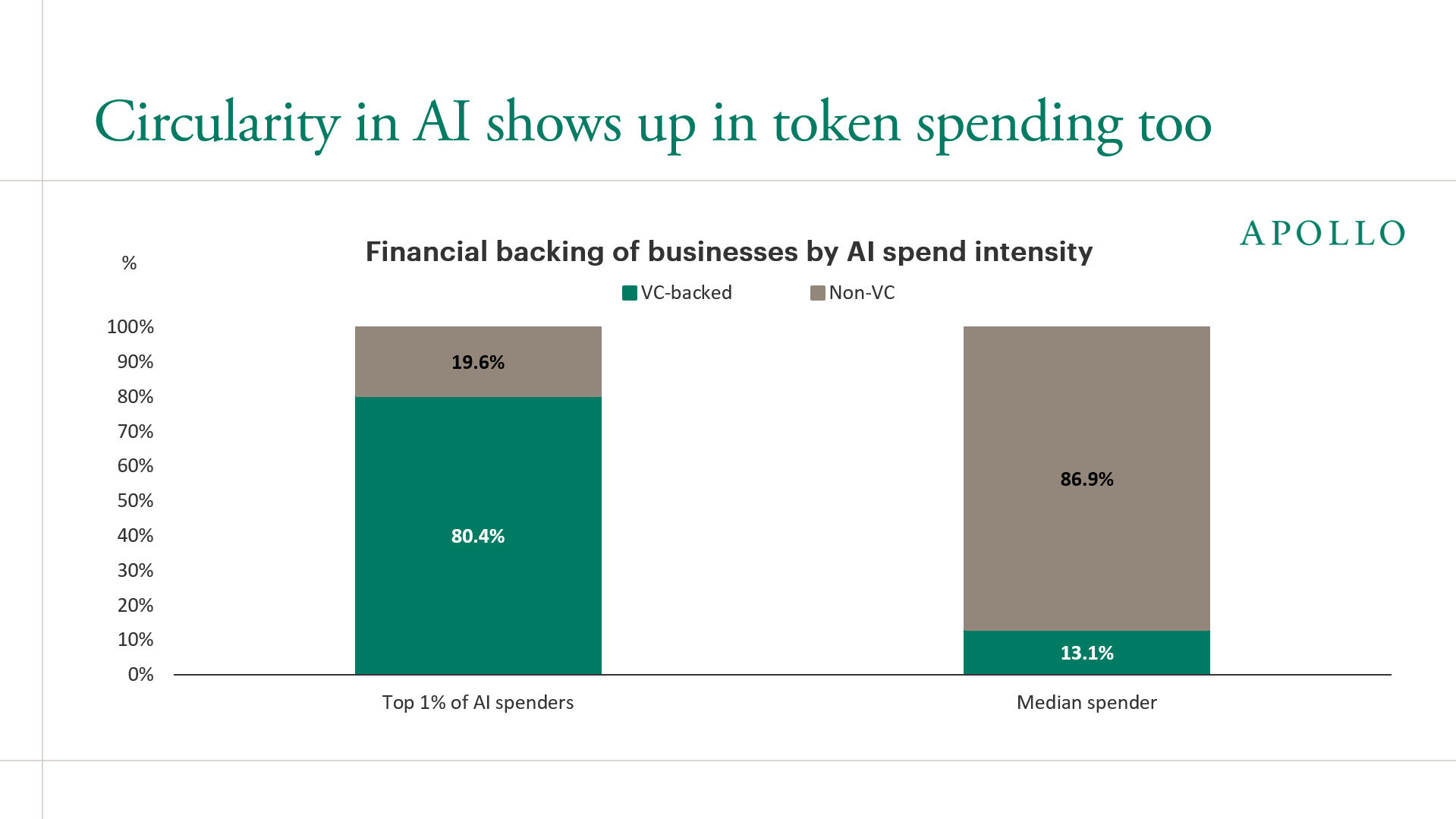
4. I don't know how you actually isolate AI productivity gains on a macro level. It seems pretty much impossible.
This whole thing is laughable.
fwlr 1 hour ago | parent
It’s weird that this has to be spelled out for so many engineers and economists, but to be very clear: OpenAI et al wants your token spend to go to one-minus-epsilon of what you previously spent on payroll, and wants your productivity to go to one-plus-epsilon of what it previously was. If you want 10x productivity, spend 9.9x more on tokens.
They are in the business of enclosure and rent extraction, and any innovation that comes out of their research and development - regardless of how real an innovation it is - will be completely contained and bent totally towards that business. Any leakage of the innovation that you experience as a productivity boost is literally felt as lost profits by them.
kristianp 41 minutes ago | parent
fwlr 19 minutes ago | parent
…plus whatever healthy premium the corporation decides it is owed for so bravely taking on those trillions of dollars of debt, once that too is paid off…
…plus whatever the expectation of return on investment the lenders were persuaded by, once that has also been met…
…only then will we get to see what proportion of the gains these corporations think it fitting to let trickle down. What do you reckon they’ll let us have? 50/50? One in ten?
twelvechairs 19 minutes ago | parent
augment_me 13 minutes ago | parent
1) If a firm spends $99k on compute to replace a $100k engineer and produces 5x the output, how is that not a 5x increase in aggregate labor productivity?
2) In your aspirin example, why wouldn't a competitor with an identical 1¢ machine sell it for 50¢ or 10¢ to take 100% of your business? You are either making the assumption that 1 company is owning the market and no models are useable beyond that one, or that all of the models that are in the front of the market have a cartel and fix the price, which is not true either looking at API costs.
sehw 1 hour ago | parent
DebtDeflation 1 hour ago | parent
Right now, the most effective use case for AI is coding agents. Software development is a profit center for the tech sector, so it's not surprising that they're seeing big gains. In Corporate America, software development is part of IT which is a cost center, and the software landscape is 30+ years of bandaid-ed legacy systems, maintained by offshore contractors who submitted the lowest cost bid, so attempts to gain productivity via AI have not been as successful.
Where Corporate America has seen gains from AI in my experience is with customer support chatbots, but the customer service function overall in Corporate America is an unmitigated disaster, so the gains are hard to measure.
Beyond these two use cases, most people in Corporate America are just using ChatGPT to create slop and copy/pasting it wherever, and then goofing off in their newly freed spare time.
We need to see new AI use cases in Operations, Finance, Marketing, etc. that can handle business processes end to end before the productivity gains start showing up in the financials.
Luker88 1 hour ago | parent
"Tech sector" is supposed to be much bigger than just 7 companies, no matter how big those 7 are.
This looks to me more like just a huge centralization of wealth.
WillAdams 1 hour ago | parent
The thing is, the failure rate was quite high --- often only 15 (sometimes fewer) lines were returned, and after a while, Microsoft imposed a limit on uploading more files, even though I was deleting the conversations immediately and quitting CoPilot and re-starting (long sessions seemed to have a progressively worse failure rate).
Since then, access to CoPilot has been removed and we're waiting on a test program to finish. Kind of curious how many tokens this was using up (and if there's a model which could be run locally which would work well and quickly enough).
verdverm 1 hour ago | parent
WillAdams 59 minutes ago | parent
I couldn't find an OCR system which was:
- free/affordable
- able to cope with arbitrary check sizes/hand-written checks and my occasional need to arrange multiple invoices in a stack with the check rotate 90 degrees so that all the numbers are visible
- which would capture the data from a scan in such a way that it could be easily used to rename the file
If you know of a system which is flexible enough to do this which is essentially free, let me know.
verdverm 43 minutes ago | parent
I did see a talk recently of fine-tuning a small LLM specifically for receipt transcription: https://www.youtube.com/watch?v=vDyxCHl-p8s
https://github.com/fw-ai/cookbook/tree/main/training/case-st...
HF has OCR LLM based models too, eg: https://huggingface.co/baidu/Unlimited-OCR
tokioyoyo 1 hour ago | parent
galaxyLogic 52 minutes ago | parent
It did save me a lot time to use AI, especially should next time since I now know which AI app can handle it. So, there was a bit of overhead before I found the AI-app and prompt that would do it.
I have another friend who works for SAP as a project manager. She said she hates the fact that management wants them to use AI for everything, giving them a bonus if they do. But one reason I think their employer insists on that is that when you try to use it for real tasks you discover what works and what doesn't. Gradually we should be getting better at it.
Currently there is still a penalty caused by
1. AI not being able to do a specific task
2. Users not knowing which AI-app can do the job and
3. How to prompt the AI to get it done.
Writing the prompt is what users must do, and writing a prompt that works is a skill they must learn for every task you want AI do for you. Therefore progres is is happening but incrementally.
ttul 1 hour ago | parent
For sake of comparison, consider e-commerce. As a proxy for "impact on the economy", we can use Amazon's revenue. They went public in 1997 and that year had revenue of $148M (just 0.14% of Walmart's revenue that year). By 2000, revenue was $2.76B (1.65% of Walmart). Bricks and mortar didn't start feeling anything until probably 2011, when Amazon crossed 11% of Walmart's revenue. And it wasn't until 2025 that Amazon finally surpassed Walmart.
But, if you worked in tech in the e-commerce business, things were already feeling pretty hot by 2007. And at that point in time, the e-commerce sector was still miniscule compared to traditional retail (~4%). Software is very exciting these days and the most fantastic things are happening. They will eventually percolate out to the rest of the economy. But it will take many years before everyone notices the difference.
geraneum 37 minutes ago | parent
What do you mean by output? LoC?
ethical 1 hour ago | parent
teekert 1 hour ago | parent
johanneskanybal 1 hour ago | parent
I would expect new disruptors to eat the lunch of the old, but that's slow.
jeffybefffy519 1 hour ago | parent
harry8 1 hour ago | parent
Not so much in accounting, which is a much easier problem.
Software devs eagerly trained their replacement.
mbil 55 minutes ago | parent
Yes there are technical solutions to such problems; I'm sure there's probably a startup to make phone calls that's hooked into your company's knowledgebase, multi-LLM workflows for document review, etc. But non-tech companies aren't adopting those. Tech companies came for the software generation and stayed for the general knowledge worker productivity. Since 2023 they made the investments to procure services, change culture, and generally re-tool. Software companies are also uniquely positioned to deal with the limitations of AI in-house, like by building custom glue components to link systems, building controls to mitigate risk, etc.
So basically the tech sector leverages AI more than other sectors. At a company level, non-tech has less investment, less training, less integration of AI with business processes. At an individual level this looks like workers having fewer tools, not knowing how to use the tools they do have, not knowing even what the tools' capabilities are, and incorporating them into their work only superficially if at all.
Someone asked me for help using AI at their job (which is tech adjacent). They were trying to create a process document using ChatGPT. Their selected model was GPT Luna Light (!), and they were copying and pasting data between ChatGPT and SharePoint. There _was_ a SharePoint integration but it lacked write access. The model was not aligning the doc images. Their prompts were not specific. It was a bad experience. Their conclusion was that AI was stupid and not worth the trouble.
So even though the non-tech sector can't take advantage of AI to the same degree that the tech sector can, they're utilizing it even less than they could be.
neuronexmachina 52 minutes ago | parent
>You can see the computer age everywhere but in the productivity statistics. Robert Solow (1987)
blurbleblurble 51 minutes ago | parent
amelius 50 minutes ago | parent
kolinko 50 minutes ago | parent
Also, it’s been just 9 months of modern claude code, and for many companies less than 6 months since first employees outside of IT got access to Claude Code. What do they expect?
kaffekaka 11 minutes ago | parent
specialp 47 minutes ago | parent
At the start of this all, execs were clamoring for "AI" and at that time the models were superficially impressive but fell short. Now I think they are all underestimating the amount of improvement in the last year. There's loads of work that can be automated
tomrod 6 minutes ago | parent
danans 43 minutes ago | parent
All of this is true, but the reality is that LLM agents free up time for people to make judgement by taking care of the grunt work, which means each person can do more. That increased efficiency can mean higher revenues in growth industries and higher profits (through reduced labor force) in stable or declining industries.
dolebirchwood 38 minutes ago | parent
osigurdson 26 minutes ago | parent
The problem isn't that "AI doesn't understand..." this or that, as concluded by the article though. Its more a lack of creativity and incorrect reasoning about what AI can and cannot do. For one, whole role replacement is pure fiction and likely will never happen with LLMs. I expect most businesses will look very different in the next 10 years due to AI and it will not be smooth as the needed creativity will mostly happen in startups (and perhaps companies that can truly operate like startups) and diffuse out from there. I'd expect a lot of churn in the S&P493 and even the M7 most likely.
so-gala-massey 24 minutes ago | parent
fritzo 7 minutes ago | parent
jmyeet 17 minutes ago | parent
We are functionally in a recession. The only way this isn't true is because of AI investment [1]. Additionally, GDP itself is flawed because it is propped up by housing, specifically imputed rent [2]. Another ticking time bomb is the $4T private equity backlog [3].
The real product of AI of labor displacement and wage suppression.
So while this article sees profits flat outside of the Mag 7, it should really be in decline to being flat is actually an improvement (IMHO).
We're not producing anything anymore. All we're doing is driving up revenues on inelastic demand on things like food, housing, electricity and health care. That's all PE is. And that's all our economy does now.
I really think people are underestimating just how close to breaking point our society is.
[1]: https://uhero.hawaii.edu/would-we-be-in-a-recession-without-...
[2]: https://www.taxresearch.org.uk/Blog/2023/02/14/10-or-gdp-is-...
dwheeler 15 minutes ago | parent
It's too early and we are probably not measuring the right things.
0xbadcafebee 7 minutes ago | parent
cs702 5 minutes ago | parent
Lots of theories seeking to explain this reality, but that's all they are: theories. Maybe they'll be proven right. Maybe not.
As of right now, the economic reality lags far behind the hype.