75 points geox 58 minutes ago 115 comments
toomuchtodo 53 minutes ago | parent
https://ourworldindata.org/grapher/solar-pv-prices
The World Crossed a Major Solar Milestone [3TW] - https://news.ycombinator.com/item?id=49151977 - August 2026
dyauspitr 50 minutes ago | parent
MSFT_Edging 46 minutes ago | parent
The real money is convincing marks to take the financing for 20+ years.
dalyons 34 minutes ago | parent
rootusrootus 26 minutes ago | parent
None? Project Solar? The last time I seriously looked at doing rooftop panels, they were significantly cheaper than the door-to-door jerks.
lightedman 26 minutes ago | parent
Untrue, at Sunspark we sold to both individuals and companies. If you can install the stuff yourself, buying it direct from the manufacturer is ungodly cheap (~330w panels at $80 a piece when I worked there almost decade ago.)
rdtsc 26 minutes ago | parent
myphpgothacked 26 minutes ago | parent
AI can't take my job then.
One indicator is that third world countries can seem to afford it.
rtkwe 24 minutes ago | parent
There's also other factors like the overall cost being beyond people's willingness to save for when financing is available or the extra value that financed installs can provide the underwriters when they're bundled and sold as a stable income stream like houses were in the mid 00s.
ghusto 22 minutes ago | parent
fatbird 9 minutes ago | parent
The fallacy is that there are infinite market opportunities but a finite supply of entrepeneurs/business/money to exploit them. Therefore, there are an infinite number of market opportunities that will get passed up for one reason or another.
rconti 24 minutes ago | parent
Qworg 46 minutes ago | parent
dataviz1000 26 minutes ago | parent
toomuchtodo 46 minutes ago | parent
The biggest cost components are sales and marketing expenses and similar soft costs. Some of this can be driven down if you collectively buy through something like https://solarunitedneighbors.org/
(have installed 100kw+ of residential solar, ama)
ramesh31 28 minutes ago | parent
toomuchtodo 23 minutes ago | parent
It's the equivalent of a bond investment with potential subsidies at the utility, state, and federal level (solar is no longer subsidized, but batteries still are).
rootusrootus 14 minutes ago | parent
So long as the roof itself lasts that long. People who are mid-cycle on their existing roof should not install solar until they get to the next replacement. This is where I am, and why I do not have rooftop solar. I expect to get 15 additional years from my roof, and there's no guarantee I will have hit the break even point by then. Plus, solar installers will not warranty a mid-cycle roof against leaks, so if something goes wrong that quickly eats into your cost savings.
BobbyTables2 18 minutes ago | parent
toomuchtodo 16 minutes ago | parent
https://www.energysage.com/news/solar-panels-withstand-hail/
- Every panel sold in the U.S. has to pass an industry-standard hail test, which fires ice balls at multiple points on the panel and requires no visible cracking, delamination, or more than a 5% drop in power output afterward. Companies like UL Solutions, an applied safety science company, test solar panels by dropping a two-inch solid steel sphere from 51 inches onto panels, simulating the impact energy of serious hail. Panels that survive without electrical hazards earn certification for real-world deployment.
- The proof is in the pudding—or in this case, the parking lot. When a severe hailstorm hammered the National Laboratory of the Rockies' (NLR) (formerly National Renewable Energy Laboratory (NREL)) Colorado campus in 2017, just one single panel out of more than 3,000 suffered damage. That's a 99.97% survival rate against Mother Nature.
lightedman 14 minutes ago | parent
Yea, if you go to an installer instead of buying from the OEM and installing yourself. I likely made your panels at SunSpark (We made panels for everyone, Renogy, Juinko Solar, Samsung, etc.) They were sold for $80 at 330w - 4.125 watts per dollar, or a quarter per watt.
Solar isn't expensive - you are.
toomuchtodo 13 minutes ago | parent
I am not a commercial system installer, I am a hobbyist enthusiast who helps others install to avoid commercial installers and their costs. Volunteer labor for everything (racking, panels, electrical), volunteer electrician signs off for any AHJ (authority having jurisdiction) requirements.
Most people cannot install the equipment themselves, which leads to the residential costs I mention. Is it expensive? Price is what you pay, value is what you get. If you cannot find someone to install for free, and cannot do it yourself, the price is the price.
(i am also a community outreach volunteer for https://www.gosolarapp.org for automating permitting and remote inspections across the US, which was incubated at NREL prior to being spun out as an independent non profit; this drives down permitting soft costs)
ForHackernews 45 minutes ago | parent
bryanlarsen 40 minutes ago | parent
Arubis 40 minutes ago | parent
benrutter 38 minutes ago | parent
nemomarx 34 minutes ago | parent
benrutter 39 minutes ago | parent
One thing that isn't super obvious from the article is that a lot of it is talking about industry solar panels rather than rooftop. The overheads of installation etc get a lot smaller if you're installing a whole bunch at once.
This isn't to say that installing solar panels on your house is a bad idea - they normally pay for themselves after something like 10 years from memory, so are similar to double glazing.
[0] https://www.energy.gov/cmei/systems/overview-trade-and-polic...
sagarm 34 minutes ago | parent
KerrAvon 21 minutes ago | parent
pfdietz 20 minutes ago | parent
rootusrootus 22 minutes ago | parent
I would guess this varies by locale, and people usually assume the time value of money to be zero when they make the claim. In much of the US, I think the payback time is more realistically in the 15-20 year range, which means you really only want to install panels when you install a new roof. Otherwise the lifetime of the roof will happen before break even on the panels.
rdtsc 21 minutes ago | parent
I am with you, this would be better on a town or regional basis instead of on everyone’s roof. Our houses already have wires going to them and I can’t imagine my particular roof or garage is the best place to put panels and batteries. But I understand it’s a political / administrative issue which may well be not solvable easily in many places.
dv_dt 26 minutes ago | parent
eppp 25 minutes ago | parent
eppp 25 minutes ago | parent
jeffbee 24 minutes ago | parent
adverbly 22 minutes ago | parent
On-prem has a problem of distributed labour costs.
On-prem might eventually become cheaper, but my guess is that won't happen any time soon.
For the time being, centralized and at-scale installation is where you can get much, much lower labour per watt costs.
Havoc 48 minutes ago | parent
Solar is cool but solar that can make it through the night and a couple cloudy days is way cooler
toomuchtodo 47 minutes ago | parent
- Battery energy storage has grown at an exceptional pace, with global installations increasing more than 20-fold in storage capacity over the past five years. This growth has been driven by falling battery prices, abundant supply and relatively short project lead times. As variable renewable generation expands in many markets, battery storage is becoming an important source of flexibility and resilience for power systems, while also representing a growing commercial opportunity for battery manufacturers.
- However, more than 90% of battery storage applications rely on LFP batteries that are almost exclusively supplied from China, which accounts for almost all global manufacturing capacity and the associated technical expertise. Korean producers are investing to scale up LFP battery production that can offer an alternative, but they face intense competition from established, lower-cost Chinese producers in an oversupplied market.
https://www.iea.org/commentaries/battery-storage-is-scaling-...
- Battery storage now accounts for around 18% of installed dispatchable capacity in Australia, compared with 7% in China, 5% in the United States and 4% in Europe – underlining how rapidly batteries are becoming an important part of the electricity systems in some regions.
https://www.ess-news.com/2026/06/02/global-battery-additions...
Battery storage is right behind the solar adoption curve. Net zero in five years? Probably not. Ten to fifteen years? Almost assured considering rate of change and the overall economics (assuming ~1TW/year of solar PV deployment and enough battery storage to soak up that low carbon generation while also providing grid services to replace thermal generation grid support [voltage, frequency, etc]).
(China is curtailing renewables equal to the annual combined generation of Spain and the Philippines every six months, and India about ~100-120GW/month due to not enough battery storage, for example)
theoreticalmal 27 minutes ago | parent
toomuchtodo 24 minutes ago | parent
My recommendation would be to see if Ecopower storage and inverters are a good fit for your use case. If you're feeling adventurous, you could build your own battery pack, but I only recommend if you are knowledgeable and confident. This comes with substantial risk, only proceed if you know what you're doing and understand the risk (I'll work on my high voltage EV battery packs, but only with a helper nearby holding a 2x4, for example).
pfdietz 28 minutes ago | parent
dieselgate 27 minutes ago | parent
literalAardvark 25 minutes ago | parent
LiFePo4 however is excellent and reasonably low cost these days
rcxdude 18 minutes ago | parent
LiFePO4 is probably the chemistry best suited to it ATM. Lasts a long time, more stable, pretty cheap, and just a bit less energy density than other lithium ion options.
dominicrose 23 minutes ago | parent
I guess using electricity to heat during the night could be an issue, but we could also accept to let the temperature drop.
masklinn 5 minutes ago | parent
jauntywundrkind 6 minutes ago | parent
Ideally we see people like Form Energies, using iron-air (rust) batteries, for much easier to scale storage. https://www.technologyreview.com/2026/10/06/1145020/2026-cli...
jillesvangurp 3 minutes ago | parent
In aggregate, grid operators have a lot of other tools at their disposal via flexible pricing, flexible demand, and automated systems that can adapt to this to e.g. charge cars when there is a surplus of energy, turn on/off water boilers, etc. There's a lot of innovation around this topic in this space. This by the way is as much as making sure generated power doesn't go to waste than it is about ensuring there is enough power. They use batteries to time shift excess power to when they can utilize it.
Interconnected grids means that e.g. an operator in Denmark can import/export to and from the UK, Norway, Germany, etc. On a windy day they'll be exporting wind power. On a sunny day, they might add some solar to that mix. When there's no wind or sun in Denmark, they might pull in Scottish/German wind, Norwegian hydro, Swedish nuclear, etc. Batteries are being deployed all over the place at a pace that is only exceeded by the pace at which solar is being deployed. Whenever there's a surplus energy, batteries get charged up. It's very rare for all of the available generation to disappear all at the same time for long enough to drain all the batteries. And for those times of course fossil generation is still a thing as well, and will be for decades to come. There are a lot of gas based plants throughout Europe. As well as some nuclear plants of course. Singling out the EU market here but it's going to be similar elsewhere.
The point here is that there's no need to pair solar setups with days/weeks/months worth of storage. A few hours goes a long way.
bhouston 38 minutes ago | parent
I guess this is in part because it only needs amazing factories and not complex deployed and maintained infrastructure that is at risk of blowing up.
Solar seems to fix the mould of a disruptive technology to a T.
pfdietz 37 minutes ago | parent
After all, if they could predict the future, why did they design a game rather than get rich in the stock market?
sheikhnbake 34 minutes ago | parent
beanshadow 33 minutes ago | parent
bhouston 28 minutes ago | parent
pfdietz 26 minutes ago | parent
bhouston 15 minutes ago | parent
https://ourworldindata.org/grapher/installed-solar-pv-capaci...
pfdietz 9 minutes ago | parent
https://news.ycombinator.com/item?id=20782346
(Needless to say, I don't have a high opinion of current fusion start ups.)
And fission already had the financial fiasco of the first nuclear build out in the US.
poszlem 36 minutes ago | parent
dv_dt 31 minutes ago | parent
xnorswap 30 minutes ago | parent
Finally, some much needed progress towards Sagan's apple pie.
bhouston 26 minutes ago | parent
numpad0 6 minutes ago | parent
cyanydeez 33 minutes ago | parent
Nuclear's problem, despite it's Champions assertion that it's now safe and properly engineered, is it's still inherently dirty and that dirt follows it through out it's life. It also probably has bloody mines, but every step on the path of using nuclear requires security and safety, and even when it's disposed, it still requires safety and security. It loses because no one trusts anyone along the entire value chain to not cut corners that leads to unsafe practices.
bhouston 27 minutes ago | parent
parineum 22 minutes ago | parent
It's from 2022, so probably outdated.
> According to the US Department of Energy (DOE), about 12% of all silicon metal produced worldwide (also known as “metallurgical-grade silicon” or MGS) is turned into polysilicon for solar panel production. China produces about 70% of the world’s MGS and 77% of the world’s polysilicon. Converting silicon to polysilicon requires very high temperatures, and in China it’s coal that largely fuels these plants. Xinjiang—a region in China of abundant coal and low electricity prices—produces 45% of the world’s polysilicon.
> Reports indicate that some Xinjiang polysilicon plants have employed forced labor of Uyghurs, an intensely persecuted Muslim ethnic minority.
[0] https://blog.ucs.org/charlie-hoffs/mining-raw-materials-for-...
numpad0 13 minutes ago | parent
I think there was some ex-French colony government that demanded France disclose details of nuclear waste burial sites for "safety" reasons, which France rejected. Which means it happens. That kind of thing is why nuclear wastes are supposedly and actually so "dangerous" and small private owned generators get "complicated".
rtkwe 32 minutes ago | parent
[0] Yes pollution from normal everyday fossil fuel power generation causes more damage and deaths in the aggregate but it's a diffuse hard to attribute kind of damage which makes it far less, for lack of a better way to say it, real to people. eg: Did living downwind of that unupgraded coal plant really kill them or is their death because of something else.
rootusrootus 28 minutes ago | parent
pfdietz 25 minutes ago | parent
jeffbee 26 minutes ago | parent
numpad0 21 minutes ago | parent
Games like SimCity often only supports ultradense Manhattan style cities and centralized solar plants through distribution networks. That combination doesn't work with solar technology. It should be like "Set up offgrid solar incentives program($1.5B)" buttons that reduces power draw proportionate to numbers of standalone houses that resets when disaster hits the parts of the map it was used on.
hibikir 2 minutes ago | parent
Solar seems to be working just fine in Spain, a place where almost nobody lives in a stand alone house, or even a row house. You still put solar in the building, but then you have industrial solar in places wi5 little agricultural value, and wind turbines installed on top of hills. All of this could work just fine in any sim city I remember, as you are just dedicating space to power, which is fine.
Megranium 11 minutes ago | parent
VeejayRampay 35 minutes ago | parent
it's a great source of energy mind you, but I kind of wince everytime people are trying to say it's better than nuclear (if you put the dangerosity of the raw material aside of course)
there are excellent storage capacities now, which helps a lot, but nuclear stays unmatched in producing vast amounts of electricity on demand (as long as we're not in a brutal heat wave to be fair)
roflmaostc 31 minutes ago | parent
I could also say: Solar is the best energy source (if you put night aside of course).
I mean obviously the main drawback of nuclear fission is the waste and the potential impact of radioactivity.
pfdietz 16 minutes ago | parent
If nuclear were just as expensive as it is now but had no waste or radioactivity it would still be struggling.
If it were 10x cheaper but still had the waste and radioactivity it would be going like gangbusters.
dalyons 30 minutes ago | parent
jeffbee 23 minutes ago | parent
lightedman 11 minutes ago | parent
Solar is the superior form of nuclear energy. You're using a big ass nuclear fusion reactor in the center of our solar system to generate energy, and you harvest that energy by capturing its photonic output.
As far as storing the energy for peak demand/nighttime usage, we've got literally hundreds of methods to do it, from pure mechanical to electrochemical.
laweijfmvo 26 minutes ago | parent
throwaway030 26 minutes ago | parent
khalic 23 minutes ago | parent
hibikir 12 minutes ago | parent
So even if a place like the US goes lighter on solar that is reasonable, Places like Spain, Italy or Morocco will go all in just to minimize dependence on a resource a third party can control. It's the ultimate counter to the Hormuz situation. Squeeze access to oil for long enough, and you accelerate the move away from it.
vatsachak 21 minutes ago | parent
HPsquared 19 minutes ago | parent
refulgentis 20 minutes ago | parent
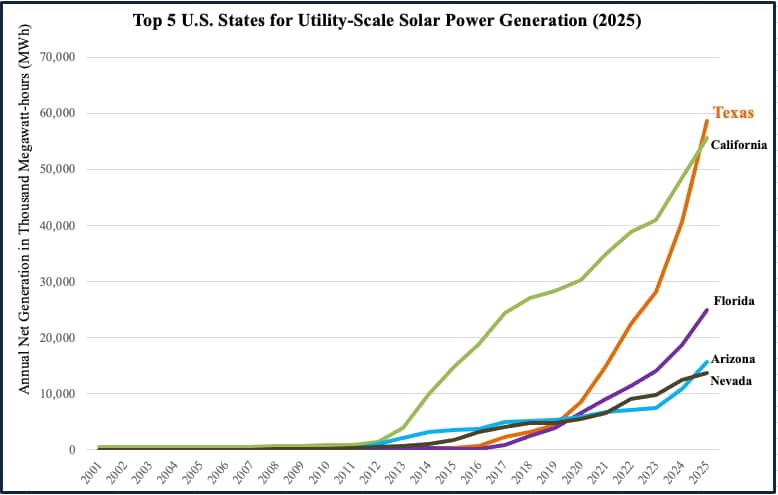
https://texas2036.org/news-analysis/growth-of-utility-scale-...
tl;dr: https://mlu3fafnp1cd.i.optimole.com/w:778/h:495/q:mauto/f:be...
bardak 17 minutes ago | parent
api 10 minutes ago | parent
It goes all the way back to this kind of thing:
https://en.wikipedia.org/wiki/The_Fundamentals
The pamphlet from which we get the term "fundamentalism" was published by an oil industry tycoon.
So the right is incentivized to protect this industry even if it becomes obsolescent and is no longer the most economical or practical way to generate at least much of our energy needs (electricity).
While the right has often sounded pro-nuclear, in practice they tend not to be that enthusiastic about it when they actually get into office. Obama supported the first new nuclear plant in decades.
https://politifact.com/factchecks/2012/mar/02/barack-obama/o...
bryanlarsen 2 minutes ago | parent
Bender 24 minutes ago | parent
mabbo 3 minutes ago | parent
https://en.wikipedia.org/wiki/Shockley%E2%80%93Queisser_limi...
You can get around it with multi-layer, but each layer adds diminishing returns on improvements, while the cost keeps increasing.
The best way to handle places with less solar irradiance is to have more panels. The cost per panel keeps dropping, so the economics keep improving in that way.
everdrive 20 minutes ago | parent
bardak 12 minutes ago | parent
stetrain 12 minutes ago | parent
The cost of the panels themselves is becoming one of the cheaper parts of that project.
serioussecurity 11 minutes ago | parent
ben_w 11 minutes ago | parent
That's on the small side of things, of course, but we also have PV-covered carports for about the same as a non-PV-covered carport: https://www.kaufland.de/product/512021383/
everdrive 17 minutes ago | parent
[edit]
According to HN you can totally do this and I'm just wrong.
abfan1127 15 minutes ago | parent
everdrive 11 minutes ago | parent
kissiel 12 minutes ago | parent
Where I live, on sunny days, the grid goes over 253V (230V nominal +10%), so in order for me to generate anything, my inverter disconnects itself from the grid.
rootusrootus 11 minutes ago | parent
[0] It is becoming way more common now, though.
HPsquared 9 minutes ago | parent
horsawlarway 4 minutes ago | parent
Most solar installs work by tying into the existing main breaker of the home.
The cheapest way to do this is to leave the line feeding from the power meter to the main panel untouched. Instead you do anti-islanding detection at the inverters, and when they detect that mains is "down" they automatically cut off to prevent trying to backfeed power to your whole neighborhood during an outage (dangerous, not a good idea).
---
Second issue - there are many appliances that are NOT happy about being turned on and off at random times, and it can significantly impact their lifespan (ex - refrigerators, acs, computers, washers & dryers, etc).
So given the variability of direct solar, you don't want to accidentally destroy your ac unit by having it turn on and off 100 times as random clouds float by.
---
But! If you're willing to install even moderate battery capacity (and LFP is getting quite cheap as well). Then you can absolutely do this. It's just more complicated and more expensive.
You need to wire in a mains relay (~$1,000 depending on the unit) and install some battery capacity to prevent very frequent startup/shutdown, then go through some painful additional signage and labeling requirements (at least in most of the US) and also install some additional shut-down switches on the exterior of the home (ex - to automatically turn the inverters off, and to shutdown the battery system).
Then, yes, you can absolutely stay on solar power while the grid is down. In the same way that people are allowed to run whole-home generators to stay online when the grid is down.
realusername 12 minutes ago | parent