185 points entryleveljobsc 3 hours ago 70 comments
mzajc 2 hours ago | parent
reaperducer 2 hours ago | parent
lrae 2 hours ago | parent
(You actually have to go through https://binary.ninja/2026/10/22/breaking-more-encrypted-usb-... first :))
adrian_b 2 hours ago | parent
forgotpwd16 1 hour ago | parent
matheusmoreira 2 hours ago | parent
alright2565 2 hours ago | parent
functionmouse 1 hour ago | parent
sllabres 1 hour ago | parent
The original IronKey (later sold to Kingston) seems to have be cracked. A team / company called Unciphered managed to break a IronKey in a attempt to offer such a decryption to Stefan Thomas who had 7002 bitcoin on this key. This was then worth then 235 million dollar (now >500 million), which is of course a VERY strong motivation. [1]
The Lenovo case of course seems not to be bad implemented security but no security at all, especially if they advertise with encryption, which I found on a Asian Lenovo website where still there are still some specs of the key [2]. A good method if you want to damage your reputation.
[1] https://www.wired.com/story/unciphered-ironkey-password-crac...
wildzzz 1 hour ago | parent
mikeryan 57 minutes ago | parent
The password was included on a sticky note in the package.
Waterluvian 2 hours ago | parent
blooalien 2 hours ago | parent
SoftTalker 53 minutes ago | parent
gruez 2 hours ago | parent
If implemented correctly, "hardware" encryption can be more secure than "free software cryptography". The most obvious benefit is protection against brute-attacks, which you can't meaningfully implement with software. Not to mention added protection of biometric authentication as a second factor, compared to typing a password into a possibly untrusted machine.
close04 1 hour ago | parent
My baseline assumption is that even the good commercial products are only secure from a non-determined attacker, not TLAs. Anything safe from TLAs is what’s being sold only to them.
gruez 1 hour ago | parent
I think you're overestimating how much backdoors there are in products vs actual bugs. As we've seen with with recent vulnerability disclosures, there's plenty of bugs that were put there unintentionally.
close04 1 hour ago | parent
The point was that there are special products, implementations of already known algorithms, sold only to TLAs. They have the code validated to the Moon and back, unlike the commercial products.
traverseda 40 minutes ago | parent
steelframe 1 hour ago | parent
close04 51 minutes ago | parent
The hardware is still a black box and you’ll never know how it behaves in conditions you didn't test against.
Sopel 1 hour ago | parent
if you have a bad password that's a user issue
gruez 1 hour ago | parent
SV_BubbleTime 44 minutes ago | parent
Did we wake up in a world without key derivation functions to turn passwords/phrases into keys?
kalaksi 44 minutes ago | parent
gruez 14 minutes ago | parent
Which doesn't do shit even if you're using argon with 32 GB memory usage or whatever. NSA is always going to be able to out-compute you. Not to mention you need a difficulty level that's usable for daily use, but the NSA can brute-force at their leisure, possibly decades in the future.
SV_BubbleTime 40 minutes ago | parent
There was a great article around last week about PDFs using randomly generated keys that ended up using non-secure random number generators and the effect was the only unique portion of the key is was 9bits, and obviously forceable. I wouldn’t even describe this between burrito bites activity as “brute”.
The point being “AES” doesn’t mean secure. Secure through the whole implementation means secure. People fuck up crypto all day, calling out a specific cipher doesn’t mean much.
TacticalCoder 1 hour ago | parent
Well you can use open-source / free software cryptography to encrypt and decrypt using a secret key which you do not need to remember and which is safely stored behind a secure element.
And there are quite a few people doing just that.
It's immensely more secure than trusting Lenovo or Microsoft or whatever company.
And you can have your secret on the secure element protected by biometric auth too (some do offer just that).
And there are devices like that with a tiny attack surface that accept biometric (like your fingerprint) to unlock the secret.
To get the best of both world you trust the HSM with one thing: the secret, and that's it. And you use open-source software and protocols (like GPG and OpenSSH) with that secret.
swinglock 2 hours ago | parent
jonathanstrange 1 hour ago | parent
bluedino 1 hour ago | parent
lokar 1 hour ago | parent
OptionOfT 5 minutes ago | parent
They work well in high security environments because you can allowlist the vendor and product id of only these hard drives, and you don't have to set up procedures where people HAVE to encrypt their drives before use.
So cost-wise it makes sense.
But for personal use? BitLocker / VeraCrypt all the way.
nik282000 2 hours ago | parent
dpacmittal 2 hours ago | parent
judge2020 2 hours ago | parent
> The fingerprint only switched the USB connection on; nothing on the card was encrypted.
swinglock 2 hours ago | parent
Loughla 1 hour ago | parent
pdpi 1 hour ago | parent
robertoandred 34 minutes ago | parent
weego 1 hour ago | parent
mytailorisrich 2 hours ago | parent
untessela 2 hours ago | parent
rendaw 1 hour ago | parent
And the article doesn't even have an image of the product as sold.
forgotpwd16 1 hour ago | parent
Thought was fake branded product at first and just no one bothered to check, but apparently is available in Lenovo CN's store.
l0new0lf-G 2 hours ago | parent
We know that Microsoft's bitlocker had at least one backdoor. Lenovo's fingerprint USB also has backdoors.
It seems like only open source solutions actually provide encryption, like LUKS and Veracrypt. Then again, who guarantees that the executables are actually build from the source? Or that the keys aren't somehow sent over to agencies by the operating system?
TLDR, we cannot realistically trust anything in this dictatorship of mass surveillance.
gruez 1 hour ago | parent
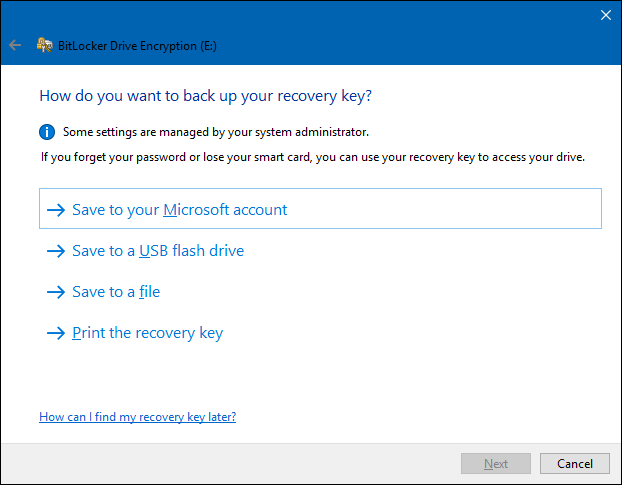
Source? The closest I found was microsoft's key escrow system, but that's hardly a "backdoor" given it's publicly documented, and it's explicitly stated in no uncertain terms when you're setting it up[1]
[1] https://static0.howtogeekimages.com/wordpress/wp-content/upl...
vel0city 1 hour ago | parent
I'm not 100% certain either way.
gruez 1 hour ago | parent
Which even microsoft admits is basically a LARP from a security point of view. It's better than nothing, but it's not meant to stand up against serious attacks. Even without the yellowkey exploit, it can be bypassed via interposer attacks on the TPM.
https://learn.microsoft.com/en-us/windows/security/operating...
aliasxneo 1 hour ago | parent
"How did you get the data?"
"It was just an unencrypted SD card inside"
Not very exciting, but I guess just as accurate as reality!
RobotToaster 1 hour ago | parent
blurbleblurble 1 hour ago | parent
icpmoles 41 minutes ago | parent
charles_f 34 minutes ago | parent
It was
forgotpwd16 53 minutes ago | parent
jqpabc123 46 minutes ago | parent
What am I missing here?
charles_f 28 minutes ago | parent
It's crazy that Lenovo will still be trusted to build secured hardware after that. It's not even a vulnerability at this point, I'm not sure how this could pass any form of security review, let alone having anyone review the design and approve it. They must have known it was nothing they pretended and still decide to sell it.
hosteur 6 minutes ago | parent